
THE STORY
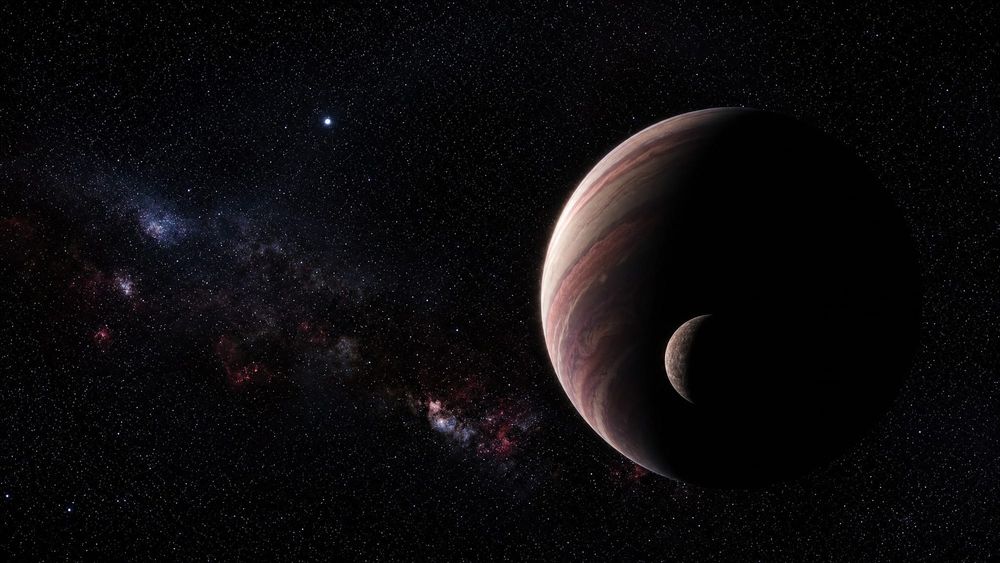
Astronomers have confirmed the detection of a moon orbiting a planet in another star system — the first verified exomoon in the history of science. The discovery, made in a solar system roughly 73 light-years from Earth, was reported this week in findings that researchers say are "challenging definitions" and "blurring the lines between stars, planets, and moons." While exoplanets have been cataloged by the thousands since the 1990s, the moons orbiting them have remained stubbornly invisible to even our most powerful instruments — until now.
The quest for exomoons has been one of astronomy's most tantalizing pursuits. For over a decade, researchers have proposed candidates — most notably around the gas giants Kepler-1625b and Kepler-1708b — only to see those detections disputed, retracted, or downgraded to "unconfirmed." The fundamental problem is one of signal: moons are small, they orbit objects that are themselves faint against the glare of their parent stars, and teasing a moon's tiny gravitational or transit signature out of stellar noise requires data of extraordinary precision. That this detection appears to hold up under scrutiny makes it a watershed moment for planetary science. The fact that the object apparently defies neat categorization — sitting at a boundary between what we'd traditionally call a moon, a planet, or something else entirely — only deepens the intrigue. At 73 light-years, the system is close enough for follow-up study with current and near-future instruments, including the James Webb Space Telescope and the upcoming Nancy Grace Roman Space Telescope.
What makes this discovery so electrifying for the space community isn't just the detection itself — it's what it unlocks. Moons are among the most promising candidates for habitability in our own solar system. Europa's subsurface ocean, Enceladus's geysers, and Titan's complex chemistry have taught us that moons can be as dynamic and interesting as planets. If exomoons are common — and there's no theoretical reason they shouldn't be — then the number of potentially habitable worlds in the galaxy could dwarf current estimates. This first detection is the crack in the dam. It validates detection methods, establishes that exomoons exist in architectures we can observe, and will almost certainly trigger a wave of targeted searches across existing exoplanet datasets. We may already have the data to find more — we just didn't know precisely what to look for.
THE DOUGH
The discovery strengthens the scientific case for flagship space telescopes and advanced ground-based observatories, reinforcing funding pipelines for instruments like Roman, the Extremely Large Telescope, and future NASA Decadal Survey missions. Companies and institutions supplying detector arrays, adaptive optics systems, and data processing infrastructure for exoplanet characterization — including Ball Aerospace, Teledyne Imaging Sensors, and university consortia — could see expanded demand. The broader astrobiology ecosystem, including startups developing biosignature detection algorithms, also gains momentum.
We are not financial analysts or investment advisors. Nothing in this newsletter constitutes investment advice. All economic analysis is speculative and for informational purposes only. Do your own research.
THE POSSIBILITIES
If this detection method proves repeatable, the total count of "potentially habitable worlds" in the galaxy could increase by an order of magnitude almost overnight. Every gas giant in a star's habitable zone becomes not one candidate, but potentially a dozen — each moon a separate roll of the dice for life.
THE HURDLES
Exomoon detections remain at the extreme edge of instrumental sensitivity, and confirmation bias is a real concern — prior candidates fell apart under additional scrutiny. The "blurring the lines" description also suggests this object may be unusual enough to resist easy classification, which could complicate efforts to generalize the finding to more conventional moon systems.
WHAT TO WATCH
- Peer review and independent confirmation of the detection by other teams and instruments
- JWST follow-up observations to characterize the exomoon's mass, orbit, and atmospheric composition
- Whether archival Kepler and TESS data yield additional exomoon candidates using the same methods
- Impact on the Roman Space Telescope's observation priority list ahead of its August 30 launch