
THE STORY
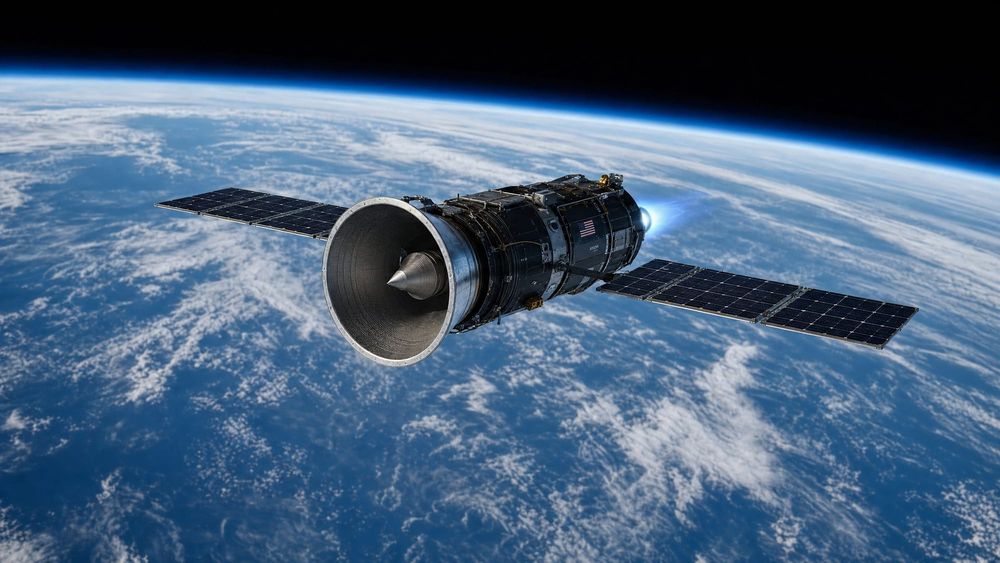
Spanish satellite startup Kreios Space announced on August 4 that it will conduct the world's first in-orbit demonstration of air-breathing electric propulsion (ABEP) in Very Low Earth Orbit, using a spacecraft bus provided by Kongsberg NanoAvionics. The mission, targeted for 2028, aims to validate a propulsion system that literally inhales the thin wisps of atmosphere found at altitudes between 150 and 250 kilometers — far below where conventional satellites operate — and uses those gas molecules as propellant in an electric thruster. If it works, it would eliminate the need for onboard propellant tanks entirely, enabling satellites to maintain orbits that would otherwise decay within weeks due to relentless atmospheric drag.
VLEO represents an untapped frontier that has been effectively off-limits to sustained operations since the dawn of the Space Age. At these altitudes, Earth-observation satellites could capture imagery at dramatically higher resolution without needing larger, more expensive optics. Radar systems would gain improved ground-penetrating capability. Communications links would benefit from reduced latency and lower power requirements. The problem has always been sustainability: atmospheric drag at 200 kilometers is punishing, and conventional satellites cannot carry enough propellant to compensate for more than a few months of station-keeping. Kreios' ABEP concept addresses this with a ram-intake collector at the satellite's leading edge that captures ambient atmospheric particles — primarily atomic oxygen and molecular nitrogen — and accelerates them through a radio-frequency ionization chamber and electrostatic grid to produce continuous, low-level thrust sufficient to offset drag indefinitely.
The 2028 demonstration will test the thruster across a range of VLEO altitudes, validating intake efficiency, thrust-to-drag ratios, and — critically — material durability in the viciously corrosive atomic oxygen environment that has degraded or destroyed hardware on previous low-orbit missions. Kongsberg NanoAvionics will provide its proven small satellite bus platform, bringing experience from more than 130 missions launched to date. For the broader industry, the mission represents a potential paradigm shift: if air-breathing propulsion works as theorized, it unlocks an entirely new orbital regime for persistent surveillance, high-resolution imaging, and low-latency communications — capabilities that every major defense agency and Earth-observation company would want access to.
THE DOUGH
If ABEP proves viable, it creates an addressable market for VLEO-optimized satellite platforms that does not currently exist. Defense and intelligence agencies are the most obvious early customers — higher-resolution imagery from lower altitudes without the cost of larger telescopes is enormously valuable. The European Space Agency has funded VLEO research programs, and companies exploring low-altitude operations would gain a critical enabling technology. Kreios could become an acquisition target for larger aerospace primes if the demo succeeds, while the broader satellite supply chain — materials companies, component manufacturers, and propulsion vendors — would need to adapt designs for the harsher VLEO environment.
We are not financial analysts or investment advisors. Nothing in this newsletter constitutes investment advice. All economic analysis is speculative and for informational purposes only. Do your own research.
THE POSSIBILITIES
VLEO satellites could enable persistent, near-real-time Earth observation without the cost, geopolitical sensitivity, or range limitations of drones. A constellation of air-breathing satellites at 200 km could provide weather monitoring, pollution tracking, and disaster-response imagery at resolutions currently achievable only by aircraft — but covering the entire planet continuously.
THE HURDLES
Atomic oxygen at VLEO altitudes is highly corrosive and has degraded materials on previous missions within months. The ABEP intake system must collect enough rarefied gas molecules to produce meaningful thrust — a physics challenge studied theoretically but never validated in orbit. And even if the propulsion works, every other subsystem — solar panels, optics, electronics shielding — must survive an environment that is fundamentally more hostile than standard LEO.
WHAT TO WATCH
- Kreios Space's mission design review milestones and 2028 launch date confidence
- ESA VLEO program funding decisions and any competitive ABEP demonstrations
- Military procurement interest in VLEO reconnaissance satellite concepts
- Material science advances for atomic oxygen resistance in satellite components
Void Economy is researched, written, and illustrated with AI, reviewed and edited by a real, live, flesh-n-blood human.