
THE STORY
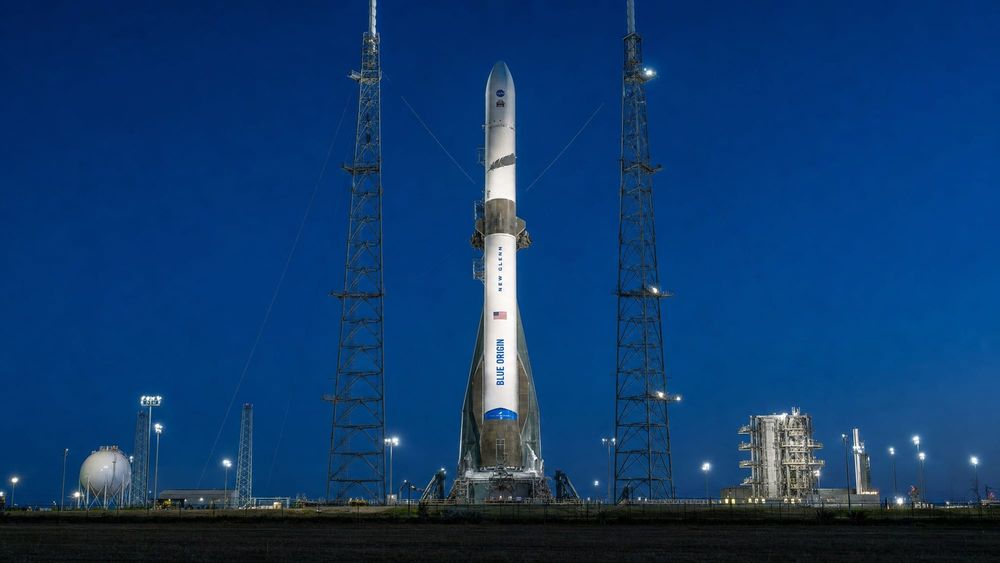
Blue Origin CEO Dave Limp revealed on August 5 that the company has traced the catastrophic explosion of its New Glenn rocket during a May 28 static-fire test to the main oxygen valve on one of the seven BE-4 engines powering the first stage. The anomaly originated in a single valve that failed during the test firing sequence, triggering a rapid unplanned disassembly that destroyed the 98-meter-tall vehicle on the pad at Launch Complex 36 in Cape Canaveral, Florida. The disclosure, delivered via a company blog post, represents the first detailed explanation of what caused the loss — and critically narrows the path back to flight from a systemic design concern to a specific, addressable component failure.
The BE-4 engine is one of the most powerful rocket engines ever built, producing approximately 550,000 pounds of thrust per unit by burning liquid methane and liquid oxygen through an oxygen-rich staged combustion cycle. It is also the engine Blue Origin sells to United Launch Alliance for its Vulcan Centaur rocket, meaning the valve issue has cross-program implications. Blue Origin said it has identified the specific failure mode and is working on both a corrective fix and a broader review of the valve's design margins across the entire BE-4 production fleet. Simultaneously, the company is advancing infrastructure plans for dual-pad capability at Cape Canaveral — a critical step toward achieving the launch cadence necessary for both commercial satellite deployment contracts and its NASA Artemis V lunar lander commitment.
Blue Origin had successfully launched New Glenn once before, in January 2025, deploying a prototype payload to orbit but failing to recover the first-stage booster on a drone ship. The May explosion was a significant setback, delaying the program by months and raising reliability questions about an engine that Blue Origin had spent over a decade developing. With the root cause now pinpointed to a discrete mechanical component rather than a fundamental engine architecture flaw, the company can begin implementing corrective actions and working toward the next ground test campaign. The timeline for return to flight remains unclear, but the specificity of the finding is a relatively positive signal for a program that needed one.
THE DOUGH
Blue Origin's recovery timeline directly affects several high-value downstream programs. NASA's Artemis V mission depends on a Blue Origin lunar lander launched aboard New Glenn. ULA's Vulcan Centaur relies on the same BE-4 engine, making any fleet-wide valve modification a cross-program logistics and cost concern. Amazon's Project Kuiper constellation has committed to multiple New Glenn launches for deploying its broadband satellites. A swift return to flight would preserve Blue Origin's competitive position in the heavy-lift market against SpaceX's Falcon Heavy and Starship, and would maintain confidence among its commercial and government customers.
We are not financial analysts or investment advisors. Nothing in this newsletter constitutes investment advice. All economic analysis is speculative and for informational purposes only. Do your own research.
THE POSSIBILITIES
Paradoxically, a catastrophic ground-test failure that yields a clear root cause can strengthen an engine's long-term reliability case. Single-point failure modes discovered during static fire are infinitely preferable to inflight surprises. If Blue Origin implements a robust fix and validates it across multiple engine tests, the BE-4 could emerge from this incident with a more credible reliability record than if the valve had degraded silently over many flights.
THE HURDLES
Blue Origin has historically moved at a deliberate pace, and a pad explosion adds months of investigation, redesign, and re-qualification testing before the next flight attempt. The company must also prove the fix works across the BE-4 fleet without disrupting ULA's Vulcan launch schedule — a delicate balancing act when your customer also depends on the engine you just blew up.
WHAT TO WATCH
- Blue Origin's announcement of the specific valve redesign and any changes to the BE-4 production line
- ULA's response regarding BE-4 valve modifications on in-production Vulcan Centaur rockets
- Timeline for the next New Glenn static fire and return-to-flight campaign
- Amazon Kuiper launch manifest adjustments and whether alternative launchers are contracted
- Progress on Blue Origin's second launch pad at Cape Canaveral
Void Economy is researched, written, and illustrated with AI, reviewed and edited by a real, live, flesh-n-blood human.