
THE STORY
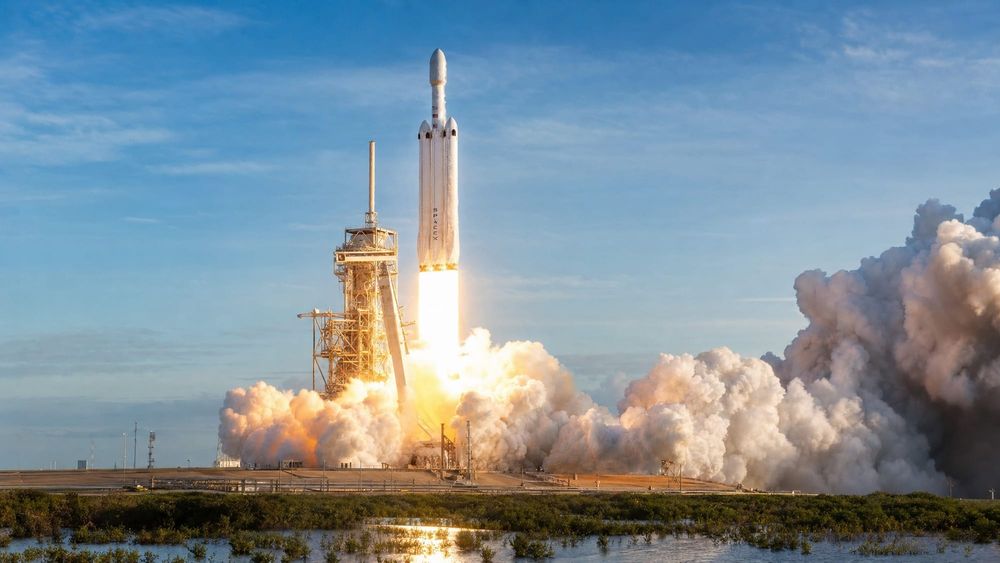
NASA's Nancy Grace Roman Space Telescope lifted off at 7:26 a.m. EDT on Sunday, August 30, aboard a SpaceX Falcon Heavy rocket from Launch Complex 39A at Kennedy Space Center, beginning a three-month, one-million-mile journey to the second Sun-Earth Lagrange point (L2). Roman is NASA's next flagship astrophysics observatory — often called the agency's fourth "Great Observatory" alongside Hubble, Chandra, and the James Webb Space Telescope — and it arrives with a mandate to tackle some of the deepest mysteries in cosmology: the nature of dark energy, the census of exoplanets across the galaxy, and the large-scale structure of the universe.
At Roman's heart sits a 2.4-meter primary mirror — the same aperture as Hubble's — but with a backstory unlike any telescope before it. The mirror was originally manufactured for a classified National Reconnaissance Office spy satellite program and donated to NASA in 2012, giving the agency a Hubble-class optic at a fraction of the usual cost. Where Hubble's camera captures a narrow sliver of sky, Roman's Wide Field Instrument delivers a field of view roughly 100 times larger. Each Roman image will cover an area of sky equivalent to about 100 Hubble ultra-deep fields, enabling surveys at a pace and scale previously impossible. Over its primary five-year mission, Roman will map hundreds of millions of galaxies, measure the shapes and distances of billions of stars, and detect an estimated 100,000 to 200,000 new exoplanets through gravitational microlensing — a technique that can find worlds too distant or dim for transit-based methods like those used by TESS or Kepler.
Roman also carries a technology demonstrator that could prove even more significant than the main survey: the Coronagraph Instrument. This experimental device is designed to block out the overwhelming glare of a host star and directly image the faint light of orbiting planets. If successful, the coronagraph will validate techniques essential for a future Habitable Worlds Observatory that would search for biosignatures on Earth-like planets around Sun-like stars. No space telescope has ever achieved this level of starlight suppression, and Roman's coronagraph aims to push performance roughly a thousandfold beyond current capabilities — a technological leap that could define the next generation of exoplanet science.
The $4.3 billion mission survived a politically turbulent road to the pad. President Trump's leaked budget proposal last year marked Roman for cancellation, but bipartisan Congressional support preserved its funding. The telescope's name honors Nancy Grace Roman, NASA's first chief of astronomy, who championed the Hubble Space Telescope and earned the title "Mother of Hubble." With Roman safely in space and its instruments cooling toward operational temperatures, the astronomy community is preparing for a data deluge that will reshape our understanding of planetary systems, galaxy evolution, and the accelerating expansion of the cosmos.
THE DOUGH
Roman validates the continued pipeline of NASA flagship missions and the billions flowing to prime contractors like the Goddard Space Flight Center integration team, L3Harris (which built the Wide Field Instrument), Ball Aerospace (coronagraph components), and SpaceX (Falcon Heavy launch services). The mission's exoplanet and dark-energy surveys will generate enormous datasets, creating demand for ground-based computing infrastructure, data-analysis software, and follow-up observation time on other telescopes — an ecosystem that benefits both institutional and commercial astronomy service providers. If the coronagraph demonstrator succeeds, it will accelerate the Habitable Worlds Observatory, projected as a $10+ billion mission that would anchor an entirely new generation of astrophysics contracts. Companies positioned in space optics, advanced detectors, and precision instrument manufacturing stand to benefit from a technology maturation pathway that Roman is now proving in flight.
We are not financial analysts or investment advisors. Nothing in this newsletter constitutes investment advice. All economic analysis is speculative and for informational purposes only. Do your own research.
THE POSSIBILITIES
Roman's microlensing survey will detect planets that no other method can easily find — including free-floating "rogue" planets drifting between stars without a host sun. If the galaxy turns out to be teeming with these orphan worlds, it would fundamentally change estimates of how much mass the Milky Way contains and could offer new constraints on dark matter distribution. The coronagraph, meanwhile, could produce the first direct image of an exoplanet in reflected starlight — a proof-of-concept that, if it works, would shift the entire exoplanet community's roadmap forward by a decade.
THE HURDLES
Roman's coronagraph is explicitly categorized as a technology demonstrator, not a science instrument — meaning its performance targets are deliberately conservative, and there's no guarantee it will achieve the contrast ratios needed for meaningful exoplanet imaging. The telescope's wide-field surveys will generate an unprecedented volume of data, and the ground-based infrastructure to process, calibrate, and distribute that data at scale is still being built out. Any delays in those pipelines could bottleneck the science return.
WHAT TO WATCH
- Roman's arrival at L2 and successful commissioning of the Wide Field Instrument over the next three months
- First-light images and early coronagraph performance data — expected in early 2027
- Whether Congress funds a follow-on Habitable Worlds Observatory study based on coronagraph results
- The volume and cadence of Roman's exoplanet microlensing detections once the survey begins
- How Roman's dark-energy measurements compare with ground-based results from the Vera Rubin Observatory
Void Economy is researched, written, and illustrated with AI, reviewed and edited by a real, live, flesh-n-blood human.