
THE STORY
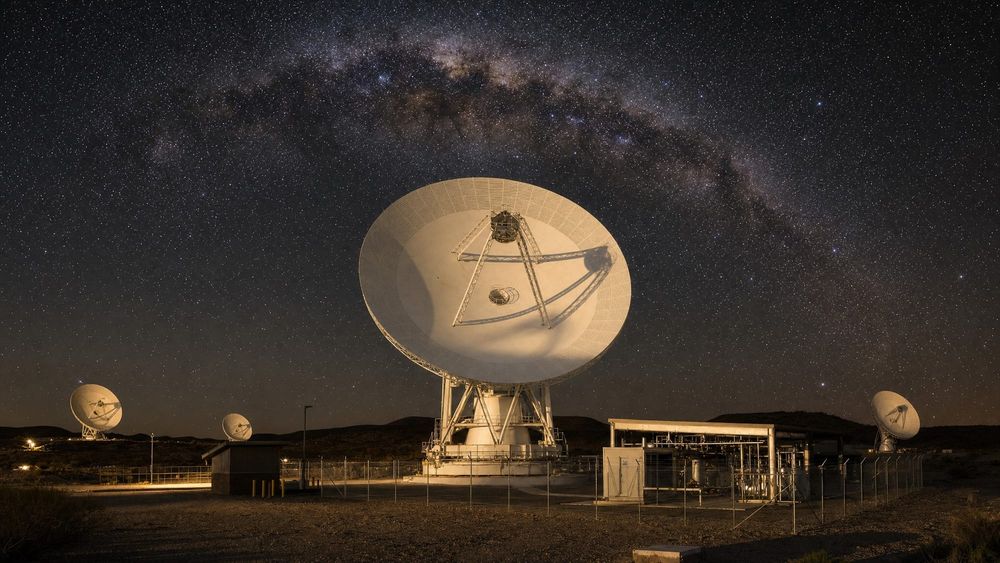
NASA held a ribbon-cutting ceremony on August 25 at the Deep Space Network's Goldstone complex near Barstow, California, formally bringing Deep Space Station 23 (DSS-23) online. The new 34-meter (114-foot) beam-waveguide antenna is the latest addition to the agency's global deep-space communications system — a network of giant dish antennas spread across three facilities in California, Spain, and Australia that serves as the sole communication link for more than 40 spacecraft exploring the solar system and interstellar space.
DSS-23 is a multifrequency beam-waveguide antenna, meaning it routes radio signals through a series of mirrors inside the antenna structure to a climate-controlled equipment room at the base — rather than mounting receivers directly at the focus point, as older antenna designs do. This architecture allows engineers to swap and upgrade receiver electronics without taking the antenna offline, and it enables simultaneous reception across multiple frequency bands. The antenna can communicate with missions ranging from Mars rovers to interplanetary probes to the Voyager spacecraft more than 15 billion miles from Earth. DSS-23 joins four other 34-meter dishes at Goldstone — DSS-24, DSS-25, DSS-26, and DSS-27 — plus the iconic 70-meter DSS-14 antenna that has served as the network's most powerful asset since 1966.
The addition comes at a critical time. The DSN has been operating near capacity for years as the number of active deep-space missions has grown without a corresponding expansion in ground infrastructure. The network must now support Artemis lunar missions, the Mars sample return architecture, the Europa Clipper mission to Jupiter's ocean moon, the recently launched Roman Space Telescope at L2, and dozens of other active spacecraft simultaneously. Each new mission demands scheduled communication windows, and oversubscription has forced mission planners to prioritize which spacecraft get data downlinks on any given day. DSS-23 directly addresses this bottleneck by adding raw antenna capacity to the busiest of the three DSN sites.
The antenna is part of the DSN Aperture Enhancement Project, a multi-year effort to add new dishes and upgrade existing ones across all three global complexes. NASA leadership, JPL managers, and DSN project staff attended the ceremony, underscoring the institutional significance of ground infrastructure that rarely gets the public attention lavished on the spacecraft it supports. Without the DSN, every deep-space mission — from the Perseverance rover on Mars to the New Horizons probe beyond Pluto — would be functionally deaf and mute. DSS-23 will enhance NASA's deep-space communication capabilities for decades to come.
THE DOUGH
The DSN Aperture Enhancement Project represents sustained government spending on ground infrastructure — contracts flowing to antenna manufacturers, RF electronics providers, and construction firms. As mission traffic increases, NASA may need additional antennas beyond what's currently planned, creating opportunities for companies that specialize in large-scale RF systems and precision mechanical structures. The growing commercial deep-space sector — including companies like Intuitive Machines, Astrobotic, and Firefly Aerospace operating beyond low Earth orbit — may eventually need commercial DSN-like services, opening a potential market for private deep-space communication networks.
We are not financial analysts or investment advisors. Nothing in this newsletter constitutes investment advice. All economic analysis is speculative and for informational purposes only. Do your own research.
THE POSSIBILITIES
The DSN's capacity constraints have quietly been one of the biggest bottlenecks in deep-space exploration — not because we can't build spacecraft, but because we can't talk to all of them simultaneously. DSS-23 eases the pressure, but the real unlock would be a shift toward optical (laser) communications for deep-space missions, which Roman is testing with its laser link. If optical comms mature, a single ground terminal could replace multiple RF dishes, potentially reshaping the entire DSN architecture within a decade.
THE HURDLES
Even with DSS-23 online, the DSN remains chronically oversubscribed relative to the growing number of missions it must serve. Building and commissioning new antennas takes years and costs hundreds of millions of dollars. The network's three-site architecture — California, Spain, Australia — also creates geopolitical dependencies, as any disruption at one complex reduces global coverage by a third.
WHAT TO WATCH
- DSN scheduling data showing whether DSS-23 measurably reduces mission queuing times
- Progress on additional Aperture Enhancement Project antennas at Madrid and Canberra complexes
- Roman Space Telescope's laser communications link performance from L2
- Whether commercial deep-space communication providers emerge to supplement NASA's DSN
Void Economy is researched, written, and illustrated with AI, reviewed and edited by a real, live, flesh-n-blood human.