
THE STORY
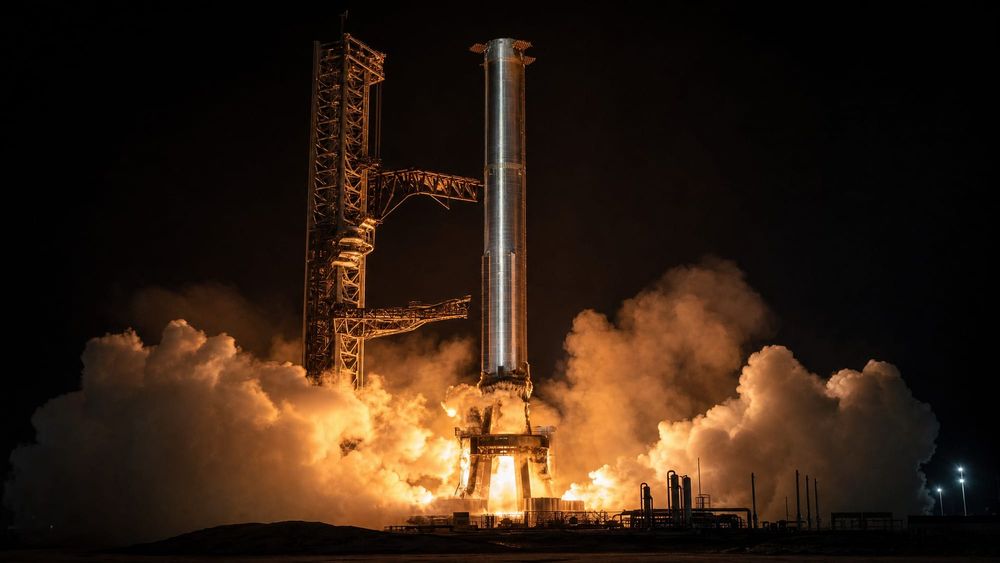
SpaceX fired up all 33 Raptor engines on a Super Heavy booster at its Starbase facility in South Texas this week, completing a full-duration static fire test in preparation for Flight 14 — the mission that will mark the first time a Starship vehicle attempts a complete orbital insertion. Previous Starship test flights have followed suborbital or partial-orbit trajectories, deliberately targeting ocean splashdown zones rather than completing a full revolution of Earth. Flight 14 changes that calculus entirely, aiming to put the upper stage into a sustained orbit before a controlled deorbit and reentry.
The static fire is the single most critical preflight gate for the Super Heavy booster. Igniting 33 Raptor engines simultaneously — each producing roughly 230 tonnes of thrust at sea level — generates combined thrust exceeding 7,500 tonnes, making Super Heavy the most powerful rocket stage ever built. The test validates engine health, propellant feed-system performance, thrust vector control, and the structural integrity of the booster under full-duration burn conditions. Any engine-out or anomaly during the static fire would require investigation and potential hardware swaps before a launch attempt.
An orbital Starship flight would be transformative for multiple reasons beyond the pure engineering milestone. NASA's Artemis III mission — the first crewed lunar landing since Apollo 17 — depends on a Starship Human Landing System variant that requires orbital refueling. Demonstrating that Starship can reach and sustain orbit is a prerequisite for every subsequent refueling demonstration, which in turn gates the entire lunar landing timeline. SpaceX has also pitched Starship as the launch vehicle for its next-generation Starlink V3 satellites, orbital data centers powered by Nvidia chips, and eventually crewed Mars transit vehicles. None of those applications work without a vehicle that can reliably achieve orbit.
The successful static fire also validates Pad 2 infrastructure at Starbase, which SpaceX has been outfitting with a new deluge system, ship quick-disconnect arm, and launch mount. Dual-pad capability at Starbase would allow SpaceX to maintain an aggressive launch cadence even while one pad undergoes post-flight refurbishment — a necessity if the company intends to approach the flight rates it has promised for both Texas and the newly announced Louisiana spaceport. The FAA launch license for Flight 14 remains pending, but SpaceX is widely expected to target a launch window in the coming weeks.
THE DOUGH
A successful orbital Starship flight would validate the foundational economics of SpaceX's entire business plan and dramatically accelerate timelines for customers ranging from NASA (Artemis HLS) to Starlink (V3 satellite deployment) to the Department of Defense (rapid heavy-lift logistics). The company's upcoming IPO — potentially the largest tech listing in history — would benefit enormously from an orbital demonstration ahead of the roadshow. Raptor engine supplier chains, including turbopump and combustion chamber manufacturers, would see increased production demands, and SpaceX's position as the dominant player in the $400+ billion global space economy would be further cemented.
We are not financial analysts or investment advisors. Nothing in this newsletter constitutes investment advice. All economic analysis is speculative and for informational purposes only. Do your own research.
THE POSSIBILITIES
An orbital Starship opens the door to in-space demonstrations that have been theoretical until now: orbital propellant transfer, payload deployment at unprecedented mass-to-orbit ratios, and potentially the first orbital data center tests. If SpaceX can demonstrate rapid turnaround between orbital flights, it could compress the timeline for Artemis III from years to months and make entirely new commercial space architectures — like orbital manufacturing platforms and space-based solar power demonstrators — economically viable for the first time.
THE HURDLES
No Super Heavy booster has yet flown with all 33 engines firing for a full mission profile without at least one engine-out scenario. The transition from suborbital to orbital flight introduces new thermal and structural challenges during the sustained upper-stage burn, and reentry from orbital velocity subjects the heat shield to conditions significantly more severe than those encountered on suborbital hops. FAA license timing remains uncertain, and any anomaly during Flight 14 could trigger months of investigation.
WHAT TO WATCH
- Static fire data review — any engine-out events or anomalies that could push the Flight 14 timeline
- FAA orbital launch license issuance for Flight 14
- Whether SpaceX attempts a booster catch on the first orbital flight attempt
- Upper-stage orbital insertion burn duration and trajectory parameters
- Pad 2 readiness and timeline for SpaceX's first dual-pad operations at Starbase Texas
Void Economy is researched, written, and illustrated with AI, reviewed and edited by a real, live, flesh-n-blood human.