
THE STORY
In a move that reads like the opening chapter of a military science fiction novel, the U.S. Space Force's Space Systems Command and its innovation arm SpaceWERX have launched a formal challenge calling on industry to develop multi-orbit "warehouses" and fuel depots — permanent logistics infrastructure in space that would allow military spacecraft to refuel, resupply, and rearm without returning to Earth. The initiative represents a major doctrinal shift, driven by the urgent need to counter increasingly aggressive adversarial maneuvering in orbit.
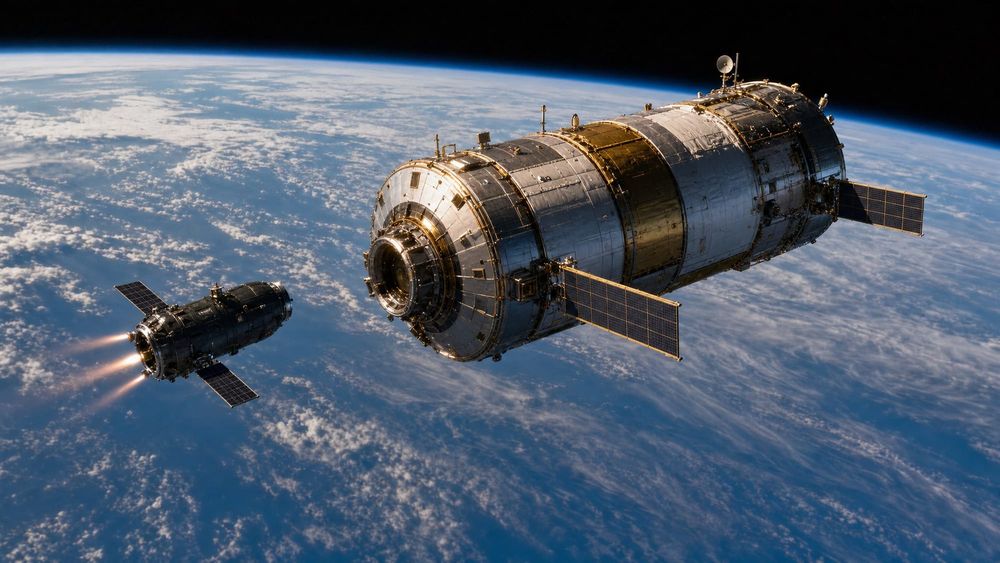
The concept is straightforward but the engineering is anything but. The Space Force envisions a network of pre-positioned supply nodes across multiple orbital regimes — low Earth orbit, medium Earth orbit, and potentially cislunar space — where military satellites and maneuvering vehicles could dock to take on propellant, swap payloads, or receive replacement components. Think of it as building a chain of orbital truck stops, except the trucks are billion-dollar reconnaissance satellites and the highway is a contested three-dimensional battlespace stretching from 200 kilometers altitude to beyond the Moon.
The challenge comes as the Space Force prepares for two planned 2027 missions to test spacecraft maneuvering capabilities, part of a broader push to develop what military planners call "space superiority" — the ability to operate freely in orbit while denying that freedom to adversaries. Current military satellites carry limited onboard propellant, constraining their ability to maneuver away from threats or reposition to cover emerging intelligence gaps. Orbital fuel depots would transform these static assets into dynamic, repositionable platforms with dramatically extended operational lives.
The technical challenges are formidable. Storing cryogenic propellants in orbit for extended periods requires solving boil-off problems that have vexed engineers for decades. Autonomous docking and fuel transfer between vehicles that were never designed for servicing demands precision robotics and standardized interfaces that the industry is only beginning to develop. And any depot becomes a high-value target — raising questions about how to defend static infrastructure in a domain where kinetic threats travel at orbital velocity. Despite these hurdles, the Space Force's willingness to issue a public challenge signals that the concept has moved from theoretical studies to active procurement planning, with industry expected to propose prototype architectures within months.
THE DOUGH
Orbital logistics is an emerging market with both military and commercial customers. Companies like Orbit Fab, which is already developing in-space refueling, and Impulse Space, which provides in-space transportation, are positioned to compete for depot contracts. The challenge also benefits propulsion manufacturers and satellite bus builders who can design vehicles compatible with standardized refueling interfaces. Defense primes Lockheed Martin, Northrop Grumman, and L3Harris will likely bid on depot architectures, while startups offer agile, lower-cost alternatives.
We are not financial analysts or investment advisors. Nothing in this newsletter constitutes investment advice. All economic analysis is speculative and for informational purposes only. Do your own research.
THE POSSIBILITIES
Military fuel depots could bootstrap the commercial in-space refueling market the same way military GPS created the civilian navigation industry. Once standardized docking and refueling interfaces exist for defense customers, commercial satellite operators will adopt them too — creating a dual-use logistics layer that makes every orbit more economically productive.
THE HURDLES
Cryogenic propellant storage in orbit remains unsolved at scale, and no operational fuel transfer between independently launched vehicles has ever been demonstrated. International legal frameworks around placing military supply infrastructure in specific orbits are murky, and adversaries may view depot construction as escalatory.
WHAT TO WATCH
- Industry proposals submitted in response to the SpaceWERX challenge
- The two 2027 Space Force maneuvering test missions and their relevance to depot concepts
- Orbit Fab's commercial refueling demonstrations and customer pipeline
- Whether NASA's Artemis orbital refueling work (SpaceX Starship) informs military depot design
- Chinese and Russian responses to U.S. orbital logistics infrastructure development