
THE STORY
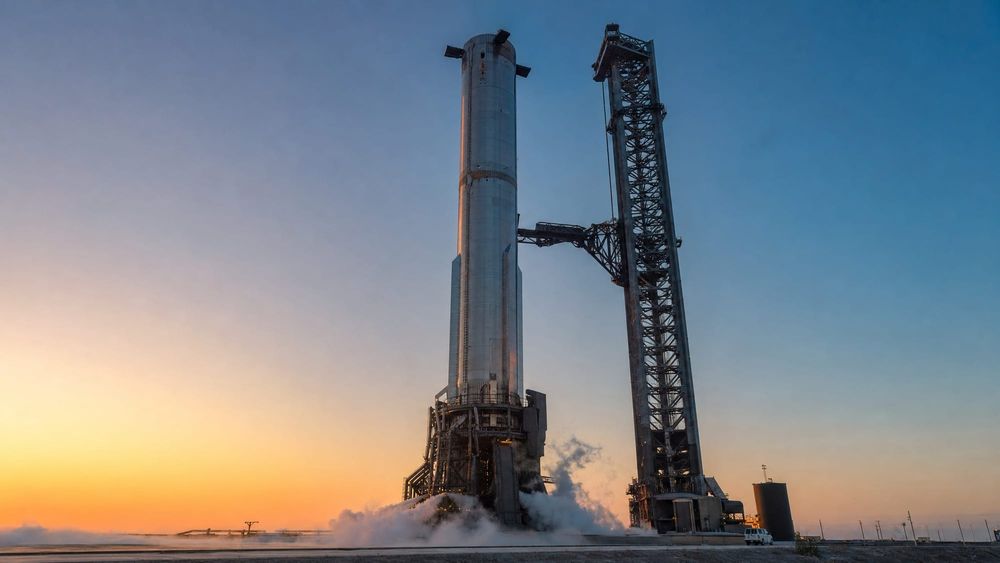
Just three weeks after Flight 12 concluded, SpaceX's Starbase teams are already deep into preparation for Starship's next iteration. Booster 20 has completed cryogenic proof testing — the critical milestone where the vehicle's propellant tanks are filled with supercold liquid nitrogen to verify structural integrity under flight-representative thermal and pressure loads — while Ship 40 is approaching static fire testing, the last major ground milestone before a vehicle is cleared for flight. The pace of turnaround underscores SpaceX's relentless manufacturing cadence and its drive to transform Starship from an experimental vehicle into an operational workhorse.
Cryogenic testing subjects the booster's stainless-steel structure to the extreme thermal gradients it will experience during flight, when liquid methane at minus 162 degrees Celsius and liquid oxygen at minus 183 degrees flow through the vehicle's plumbing and into 33 Raptor engines. Any structural weakness — a weld defect, a tank wall imperfection, a fitting that doesn't seal under thermal contraction — would show up during this test as a pressure anomaly or visible deformation. Booster 20's clean cryo is a green light for static fire, where all 33 engines will ignite simultaneously on the pad.
Ship 40, meanwhile, is progressing through its own pre-flight checkout at the Starbase facilities in Boca Chica, Texas. SpaceX has been iterating rapidly on the upper-stage vehicle, incorporating lessons learned from previous flights including heat shield performance, flap actuator behavior during reentry, and propellant management during the flip-and-burn landing sequence. A successful Ship 40 static fire would clear the way for stacking on Booster 20, integration testing, and eventually a launch attempt — though the FAA licensing timeline remains a variable that SpaceX does not control.
Flight 13's importance extends well beyond SpaceX's test program. Every Starship flight brings the vehicle closer to the configurations needed for NASA's Artemis Human Landing System, orbital refueling demonstrations, and the company's newly revealed orbital data center ambitions. With SpaceX now a public company under intense investor scrutiny, the pressure to demonstrate rapid flight cadence and vehicle reliability is higher than ever. A successful Flight 13 would further validate the rapid-iteration development model that has become SpaceX's signature — and justify the $2 trillion valuation investors just assigned to the enterprise.
THE DOUGH
Starship's flight cadence directly affects SpaceX's revenue trajectory for both Starlink deployment and future HLS contract milestones. Each successful flight also de-risks the orbital data center plans that ARK Invest estimates could generate $300 billion in annual revenue. Suppliers across the Raptor engine supply chain, heat shield tile manufacturers, and ground systems contractors all benefit from accelerating test tempo. For competitors like Blue Origin and ULA, SpaceX's pace sets the benchmark against which their own programs are measured by both customers and investors.
We are not financial analysts or investment advisors. Nothing in this newsletter constitutes investment advice. All economic analysis is speculative and for informational purposes only. Do your own research.
THE POSSIBILITIES
If SpaceX achieves monthly Starship flights by late 2026, it would create a launch surplus that fundamentally changes what's economically viable in orbit — from massive space stations to asteroid mining precursors to the kind of bulk cargo delivery that turns the Moon from a destination into a construction site.
THE HURDLES
Thirty-three-engine static fires remain inherently high-risk events, and any anomaly could set timelines back by months. FAA licensing continues to pace SpaceX's launch cadence, and the agency's environmental review process does not move at Starship speed. Heat shield durability during reentry also remains an area of active iteration.
WHAT TO WATCH
- Booster 20 static fire results — particularly any engine-out scenarios
- Ship 40 static fire timing and post-test inspection results
- FAA launch license issuance for Flight 13
- SpaceX's first public investor update on Starship development timeline
- Progress on orbital refueling demonstrations needed for Artemis HLS