
THE STORY
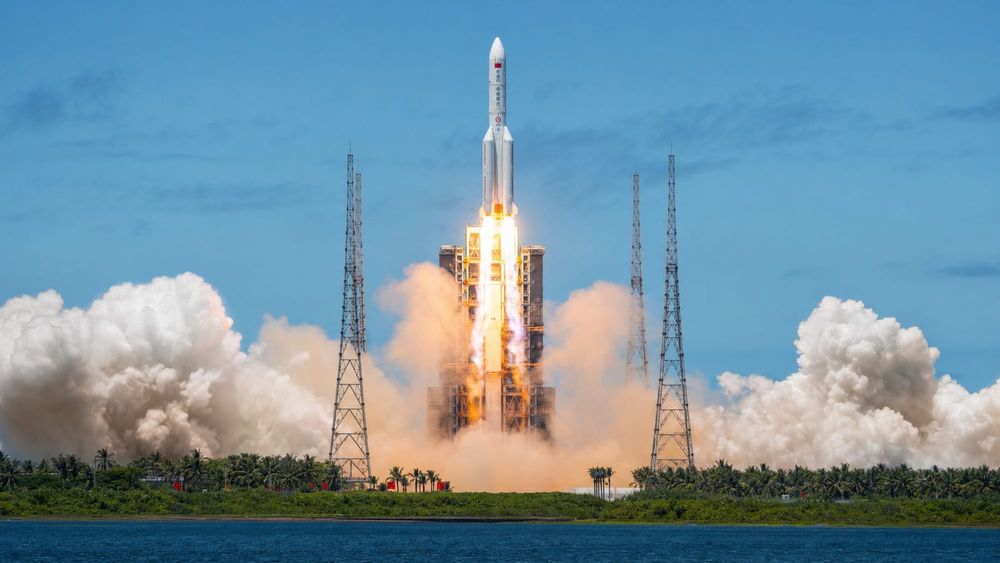
China kicked off an exceptionally busy month with the successful maiden flight of its tallest rocket, a significant milestone in Beijing's campaign to close the gap with SpaceX in launch capability. The vehicle completed three missions for a single internet constellation, demonstrating the kind of rapid operational cadence that China's growing commercial space sector will need to deploy its planned mega-constellations. Simultaneously, commercial launcher LandSpace is preparing for its second landing attempt with its methane-fueled Zhuque-2E, signaling that Chinese firms are aggressively pursuing the reusable rocket paradigm that SpaceX has dominated.
The new rocket's debut comes as China's private launch companies eye their own public listings, with several targeting IPOs in the wake of SpaceX's Nasdaq debut. Chinese commercial launchers have proliferated rapidly over the past three years, with companies like LandSpace, iSpace, Galactic Energy, and Deep Blue Aerospace all pursuing reusable first stages. LandSpace's Zhuque-2E, powered by a methalox engine cycle similar to SpaceX's Raptor, represents one of the most advanced Chinese commercial rockets and its landing attempts are closely watched as indicators of China's reusability timeline.
The constellation deployment missions highlight another dimension of the competition. China has filed for over 200,000 satellite positions with the International Telecommunication Union, a move that would dwarf even Starlink's planned constellation size and secure orbital slots that, once claimed, are difficult for competitors to contest. Building the rockets to launch these constellations at competitive cost is the bottleneck, and China's new heavy-lift vehicle is designed specifically to address that capacity gap. The successful debut flight demonstrates that China's launch infrastructure is scaling, even if individual vehicle reusability still trails SpaceX by several years.
THE DOUGH
China's commercial space sector is attracting significant domestic investment as the government prioritizes space infrastructure as a strategic industry. Chinese rocket companies planning IPOs in Hong Kong and mainland exchanges could collectively raise billions, creating a parallel space capital market to the U.S. ecosystem. Western investors with exposure to the broader space supply chain should monitor Chinese launch cadence as a competitive variable affecting Starlink's addressable market and global spectrum allocation.
We are not financial analysts or investment advisors. Nothing in this newsletter constitutes investment advice. All economic analysis is speculative and for informational purposes only. Do your own research.
THE POSSIBILITIES
If LandSpace achieves booster landing, China would become only the second nation with an operational reusable orbital rocket — a capability that could accelerate Beijing's mega-constellation deployment timeline by years and pressure Western regulators to fast-track spectrum approvals for competing systems.
THE HURDLES
Chinese commercial launchers still operate at a fraction of SpaceX's flight rate, and first-stage recovery remains undemonstrated. Export controls on Western components and the geopolitical complexity of international spectrum coordination could limit Chinese constellation services to domestic and Belt-and-Road markets.
WHAT TO WATCH
- LandSpace Zhuque-2E second landing attempt results
- Chinese commercial launcher IPO filings in Hong Kong
- WRC-27 spectrum allocation battles in Shanghai next year
- Pace of Chinese internet constellation satellite deployments