
THE STORY
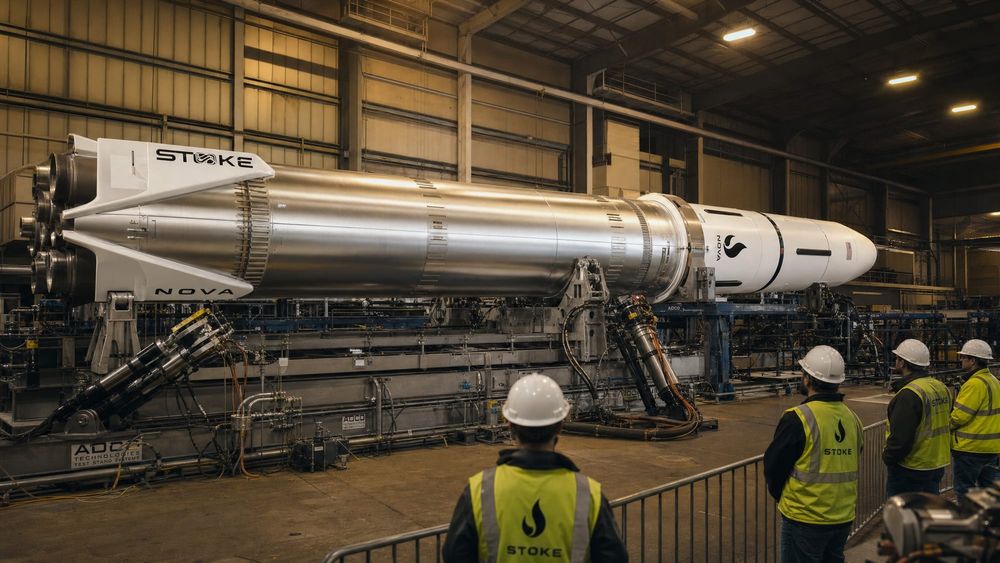
Stoke Space has completed structural verification testing of the first stage of its Nova rocket, a critical proto-qualification milestone that proves the vehicle's airframe can withstand the loads it will experience during flight. The achievement, announced from the company's testing facilities, advances one of the most technically audacious fully reusable rocket programs in the industry — a vehicle designed from day one for complete reusability of both stages, including a second stage that returns to Earth vertically using a novel ring of differential-thrust engines around its base.
Nova's first stage structural verification involved subjecting the hardware to loads representative of maximum aerodynamic pressure, engine thrust, and staging events. Passing this test means the airframe design is locked and production hardware can begin flowing toward integration and eventually static fire. Stoke's approach differs fundamentally from SpaceX's iterative "build, fly, learn" methodology — the company has invested heavily in ground testing before attempting flight, betting that a more thorough pre-flight qualification program will reduce the number of flight failures needed to reach operational status.
What makes Stoke Space particularly interesting is its second-stage reuse concept. While SpaceX has demonstrated first-stage recovery thousands of times, no company has recovered and reused an orbital second stage. Stoke's approach uses a ring of 30 small engines around the second stage's base that can throttle individually, enabling the stage to reenter the atmosphere base-first — using the engines as a distributed heat shield — and then land vertically. If successful, full two-stage reusability would dramatically reduce launch costs beyond even what Falcon 9 has achieved, since the second stage represents a significant fraction of a rocket's total cost.
THE DOUGH
Stoke Space has attracted significant venture funding from investors betting that full reusability represents the next frontier in launch economics. The company competes with Rocket Lab's Neutron and Relativity Space's Terran R for the medium-lift reusable rocket market. A successful Nova program would validate the technical feasibility of second-stage reuse and could attract government contracts from the Space Force and NASA.
We are not financial analysts or investment advisors. Nothing in this newsletter constitutes investment advice. All economic analysis is speculative and for informational purposes only. Do your own research.
THE POSSIBILITIES
If Stoke achieves full two-stage reusability, it would force SpaceX and every other launch provider to match the capability or accept a structural cost disadvantage — potentially triggering the next revolution in launch economics.
THE HURDLES
Second-stage reentry and recovery is an unsolved engineering problem. The thermal and aerodynamic challenges of bringing a lightweight upper stage through the atmosphere intact are fundamentally different from — and arguably harder than — first-stage recovery. Stoke must also secure launch site access and regulatory approvals.
WHAT TO WATCH
- Nova first-stage static fire timeline
- Second-stage hover and landing test demonstrations
- Launch site selection and FAA licensing progress