
THE STORY
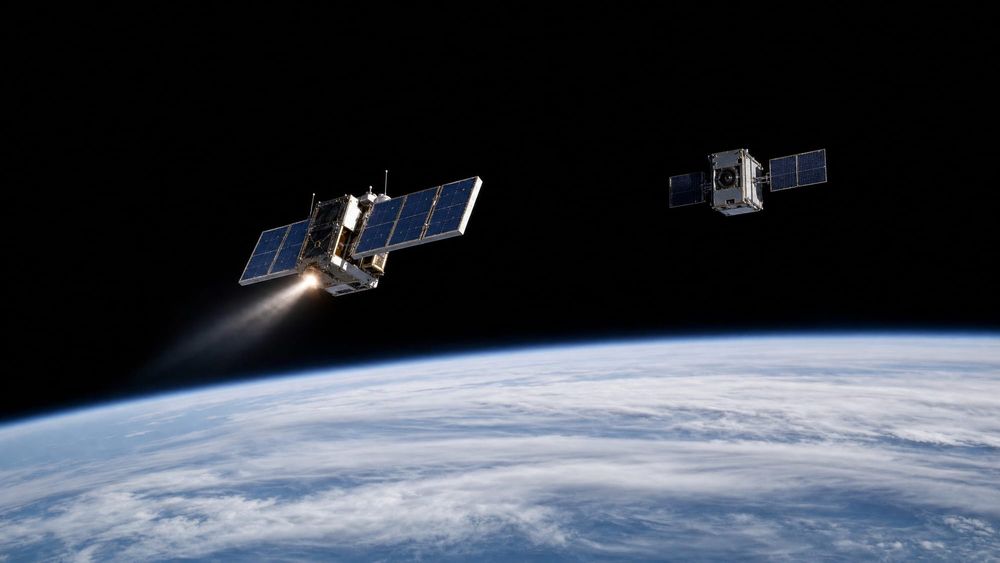
The U.S. Space Force's Victus Haze mission has completed what may be the first publicly acknowledged space-to-space pursuit between two spacecraft, with True Anomaly's Jackal-0004 satellite and a Rocket Lab-built Puma spacecraft engaging in orbital maneuvers that Ars Technica compared to "Top Gun in orbit." True Anomaly detailed the pursuit this week, describing how its Jackal satellite tracked, approached, and maintained proximity to the Puma vehicle in a demonstration designed to test the military's ability to inspect, characterize, and if necessary respond to adversarial activity in orbit. As one participant noted, "Dogfighting in space doesn't quite have the drama of an aerial dogfight" — but the strategic implications are profound.
Victus Haze is part of a growing portfolio of Space Force missions designed to prove that the U.S. can rapidly detect, track, and respond to threats in the space domain. Unlike traditional military satellite programs that take years to develop and deploy, the Victus series emphasizes speed and commercial partnerships. True Anomaly, a Colorado-based startup, has been developing its Jackal spacecraft as a platform for space domain awareness and orbital inspection — essentially building the eyes and ears that would allow the military to understand what adversary satellites are doing in real time. The Puma spacecraft, built by Rocket Lab, served as a cooperative target for the exercise, but the underlying capabilities being tested apply directly to scenarios involving uncooperative or hostile objects.
The mission arrives as geopolitical competition in orbit intensifies. China has demonstrated co-orbital inspection capabilities, Russia has tested anti-satellite weapons, and the growing congestion of the GEO belt makes space domain awareness increasingly critical. The Space Force's investment in commercial companies like True Anomaly and Rocket Lab to perform these missions — rather than building classified military-only systems — signals a strategic bet that commercial speed and innovation will outpace traditional defense acquisition in the space domain.
THE DOUGH
True Anomaly, Rocket Lab, and other commercial space domain awareness companies are positioned to capture a growing share of military spending on orbital operations. The Space Force's broader Andromeda program has already awarded $1.8 billion across 14 companies for GEO surveillance satellites, and the Victus missions demonstrate complementary capabilities in LEO. Defense ETFs and space-focused funds gain exposure to a market where government spending commitments provide multi-year revenue visibility.
We are not financial analysts or investment advisors. Nothing in this newsletter constitutes investment advice. All economic analysis is speculative and for informational purposes only. Do your own research.
THE POSSIBILITIES
The capability demonstrated here isn't just defensive — it's the foundation for active space traffic management. A spacecraft that can autonomously pursue, inspect, and characterize other objects in orbit is also a spacecraft that can verify compliance with debris mitigation rules, inspect damaged satellites for insurance purposes, or approach and de-orbit defunct objects. The military application comes first, but the commercial applications may ultimately be larger.
THE HURDLES
Space pursuit against cooperative targets is a very different challenge than operating near adversary satellites that may be maneuvering evasively or carrying countermeasures. International norms for close-approach operations in space remain undeveloped, and aggressive proximity operations risk being misinterpreted as hostile acts — potentially triggering escalation rather than deterrence.
WHAT TO WATCH
- True Anomaly follow-on contracts and whether Jackal becomes an operational Space Force asset
- Space Force's Victus series continuation with more complex scenarios
- International reactions to U.S. demonstrations of space pursuit capabilities
- Commercial applications emerging from the orbital inspection technology