
THE STORY
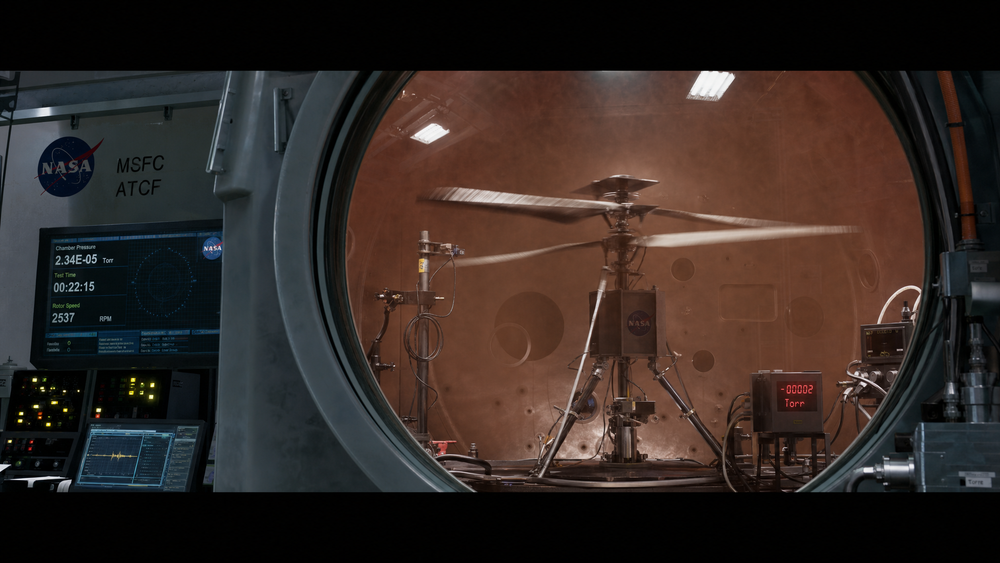
NASA is testing rotors for its next-generation Mars helicopters, and in a video released this week, a test rotor achieved supersonic tip speeds — breaking the sound barrier under conditions simulating Mars' ultra-thin atmosphere. The work is part of NASA's effort to develop a fleet of larger, more capable Mars aircraft that could serve as scouts, sample transporters, or even autonomous exploration vehicles for future missions. Ingenuity, the 1.8-kilogram proof-of-concept that flew 72 times on Mars before its mission ended, demonstrated that powered flight is possible in the Martian atmosphere, which is less than 1% the density of Earth's. The next generation aims to carry meaningful payloads over much greater distances.
Achieving supersonic rotor tips means NASA can spin blades fast enough to generate lift in Mars' vanishingly thin air while carrying heavier payloads — a fundamental engineering breakthrough for Mars aviation.
THE DOUGH
Mars helicopter technology feeds directly into NASA's Mars Sample Return architecture and future human exploration planning. Companies developing lightweight composite materials, miniaturized avionics, and autonomous flight systems for planetary aircraft could see growing NASA contracts. The broader market for autonomous aerial vehicles in extreme environments — from Mars to Venus to Titan — represents a long-term opportunity for aerospace suppliers willing to invest in unconventional flight regimes.
We are not financial analysts or investment advisors. Nothing in this newsletter constitutes investment advice. All economic analysis is speculative and for informational purposes only. Do your own research.
THE POSSIBILITIES
A fleet of capable Mars helicopters changes the exploration paradigm from "drive to interesting rocks" to "fly to interesting terrain." Helicopters could reach cliff faces, cave entrances, and steep crater walls that no rover can access — exactly the places most likely to harbor evidence of past or present life.
THE HURDLES
Supersonic rotor tips create enormous stress on blade materials and bearings, and Mars' extreme temperature swings (-80°C to 20°C daily) compound the fatigue problem. No flight-qualified next-gen Mars helicopter has been built yet. And any Mars aircraft must be autonomous — the 4–24 minute communication delay with Earth makes real-time piloting impossible.
WHAT TO WATCH
- NASA's timeline for selecting a next-gen Mars helicopter design
- Integration of helicopter capabilities into Mars Sample Return mission planning
- Full-scale rotor testing in Mars atmospheric simulation chambers
- Autonomy software development for beyond-line-of-sight Mars flight