

THE STORY
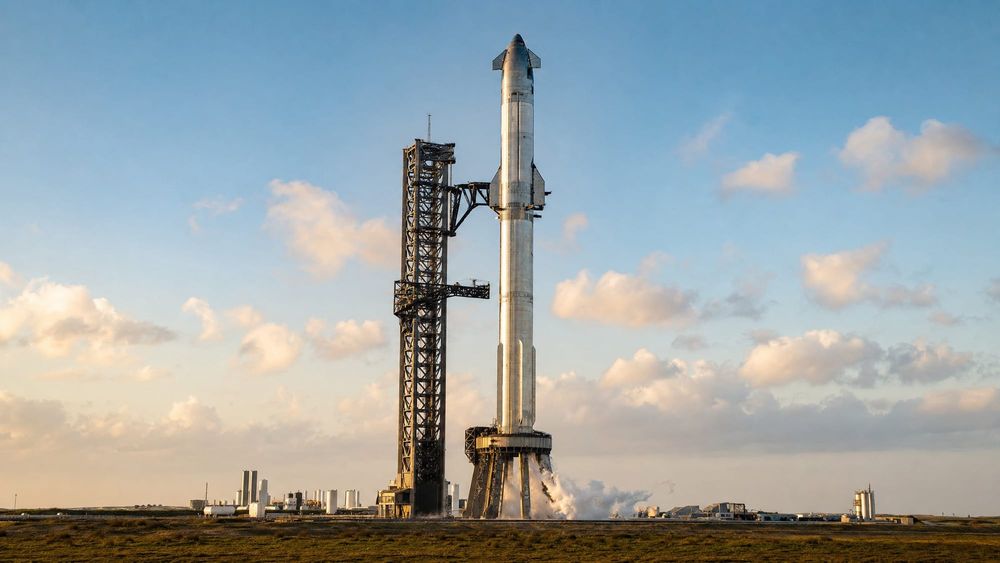
SpaceX aborted the launch of Starship Flight 13 on July 16 when four of the Super Heavy booster's 33 Raptor engines failed to ignite at T-zero, triggering an automatic shutdown of the entire vehicle. The company immediately began offloading propellant and announced a new target date of Monday, July 20, with the launch window opening at 6:45 p.m. ET from Pad 2 at Starbase in South Texas. The abort marked the first Starship test flight since SpaceX went public in a record-breaking IPO, putting the company's "fly, fail, fix" development philosophy under scrutiny from public-market investors for the first time.
Flight 13 was intended to be the second launch of the Version 3 Starship and Super Heavy configuration and carried an ambitious manifest: the first-ever deployment of V3 Starlink satellites, tests of booster recovery systems, and validation of upgraded flight software. The V3 Starlink satellites are significantly larger and more capable than current-generation units, featuring enhanced direct-to-device communications capabilities and more powerful laser inter-satellite links. Getting them to orbit is a critical step in SpaceX's plan to upgrade the entire Starlink constellation — and in turn, a key revenue driver ahead of the company's first earnings report as a public entity.
SpaceX CEO Elon Musk confirmed the engine ignition failure on social media, and the company indicated it is studying what caused the automated scrub. Engine-out scenarios on the Super Heavy booster are not unprecedented — the vehicle is designed with redundancy sufficient to complete missions even with several engines offline — but a failure to ignite four engines at the pad suggests a systems-level issue rather than individual engine anomalies. SpaceX shares, which had already fallen below the $135 IPO price earlier in the week, dropped an additional 4% in after-hours trading before partially recovering. The July 20 retry, if successful, would provide significant relief to a stock that has shed over $800 billion in market value from its post-listing peak.
THE DOUGH
The abort underscores the tension between SpaceX's iterative development approach and public-market expectations for predictable execution. Analysts at MoffettNathanson initiated coverage with a "Neutral" rating citing valuation concerns, while BofA's Ronald Epstein maintains a bullish outlook anchored in SpaceX's launch market dominance. The V3 Starlink satellite deployment is particularly consequential for revenue projections, as Starlink remains SpaceX's primary revenue engine. Any delay in upgrading the constellation directly affects subscriber growth and service quality forecasts that underpin the company's valuation.
We are not financial analysts or investment advisors. Nothing in this newsletter constitutes investment advice. All economic analysis is speculative and for informational purposes only. Do your own research.
THE POSSIBILITIES
Paradoxically, a quick turnaround from abort to successful flight would demonstrate exactly the operational resilience that makes SpaceX exceptional. If the company can identify the ignition issue, fix it, and fly within four days, it would validate the Starbase infrastructure investment — including the dual-pad capability — as much as any nominal flight would.
THE HURDLES
Four-engine ignition failures suggest a shared cause — potentially a propellant conditioning issue, an avionics sequencing error, or a ground systems problem — that may require more than a few days to resolve. FAA launch license revalidation could also introduce delays if the agency requires additional review of the abort anomaly.
WHAT TO WATCH
- Whether SpaceX holds the July 20 target date or slips further
- Root cause disclosure for the four-engine ignition failure
- SpaceX's first public earnings report date and Starship discussion
- V3 Starlink satellite deployment success on the retry flight
- Lockup expiry timing and insider selling pressure on SpaceX shares


