
THE STORY
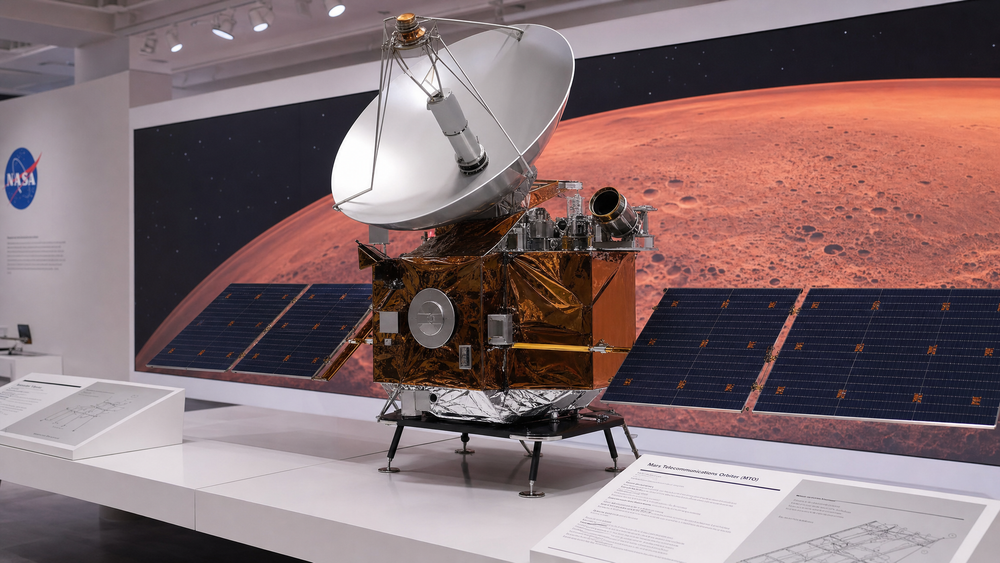
NASA has released the final Request for Proposals for its Mars Telecommunications Network — a system of orbiters at the Red Planet designed to relay science data, high-definition imagery, and critical communications for future surface, orbital, and human exploration missions. The RFP confirms technical requirements that limit the number of companies capable of bidding, favoring firms with deep-space telecommunications heritage and large spacecraft manufacturing experience. The network will succeed the aging Mars Reconnaissance Orbiter and MAVEN as the primary data relay infrastructure at Mars, and is being designed to support the dramatically higher bandwidth requirements of eventual human missions.
By turning to industry for Mars telecommunications, NASA is extending the commercial space model beyond Earth orbit for the first time in a major infrastructure program.
THE DOUGH
The Mars telecommunications contract could be worth billions over its lifetime and establishes a commercial precedent for deep-space infrastructure. Companies like Lockheed Martin, Northrop Grumman, and potentially newer entrants with proven deep-space telecom capabilities are expected to compete. The program also creates downstream opportunities for ground segment providers, antenna manufacturers, and laser communications companies — especially given the high-bandwidth requirements that will likely demand optical links in addition to traditional radio frequency systems.
We are not financial analysts or investment advisors. Nothing in this newsletter constitutes investment advice. All economic analysis is speculative and for informational purposes only. Do your own research.
THE POSSIBILITIES
A commercial Mars telecommunications network sets the template for how all future deep-space infrastructure gets built. If NASA can procure Mars comms as a service rather than a one-off government mission, the same model could extend to lunar relay networks, asteroid belt communications, and eventually the infrastructure backbone for human settlements beyond Earth.
THE HURDLES
The stringent technical requirements effectively limit bidders to a handful of established aerospace primes, potentially reducing competitive pressure. Mars missions have a notoriously high failure rate, and any delay in deploying the telecom network cascades into Mars Sample Return and human exploration timelines. NASA's budget remains constrained, and the program must compete with Artemis, ISS transition, and other priorities for funding.
WHAT TO WATCH
- Industry teams that submit proposals and their partnership structures
- Whether the contract includes provisions for commercial data relay services beyond NASA
- Laser communications technology selection for Mars-distance optical links
- Integration with Mars Sample Return mission timeline