
THE STORY
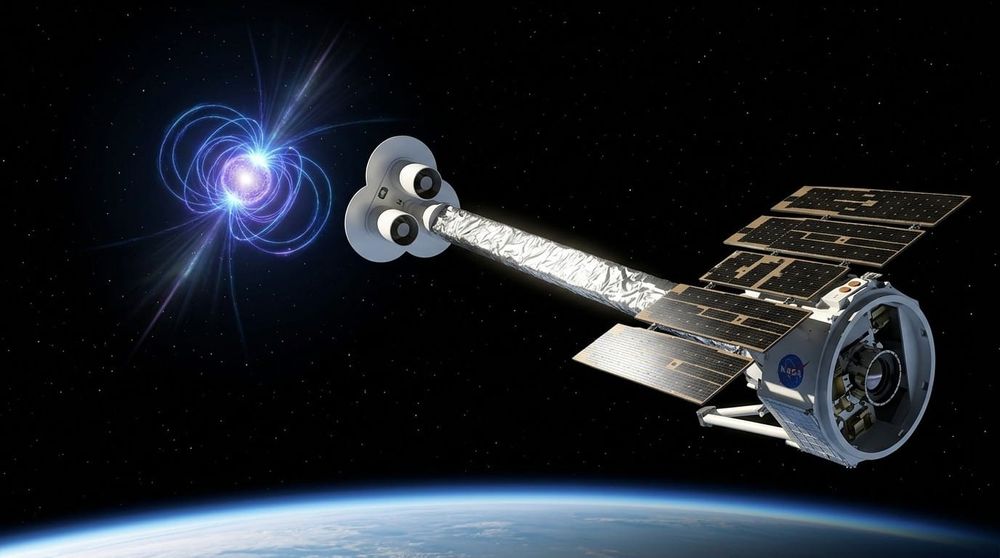
Scientists using NASA's IXPE (Imaging X-ray Polarimetry Explorer) may have captured the first direct evidence of vacuum birefringence — a quantum electrodynamics phenomenon predicted in the 1930s but never directly observed — by studying the magnetar 1E 1547-5408 for more than 140 hours between March and April 2025. The results, published in Nature on August 6, 2026, suggest that the extreme magnetic field around the magnetar causes supposedly "empty" space itself to behave like a crystal, splitting and polarizing X-ray light in ways that classical physics says should not happen. If confirmed by further observation, it would be one of the most significant experimental validations of quantum electrodynamics in astrophysical conditions.
A magnetar is a neutron star with an extraordinarily powerful magnetic field — trillions of times stronger than Earth's. At these staggering intensities, quantum theory predicts that the vacuum — the space between atoms, the emptiness itself — becomes birefringent, meaning it splits light into two polarization components that travel at slightly different speeds. This is the same effect that makes calcite crystals split a beam of visible light into two images. Werner Heisenberg and Hans Euler predicted this behavior in 1936 as a consequence of quantum electrodynamics, but the magnetic field strengths required are so extreme that no laboratory on Earth has ever come close to reproducing the conditions. Only magnetars — nature's most intense magnets — provide environments where the effect might be detectable at all.
IXPE, launched in December 2021, is the first space telescope specifically designed to measure the polarization of X-rays from cosmic sources. Its three mirror assemblies focus X-rays onto gas pixel detectors that measure not just each photon's energy and arrival direction but also its polarization angle — the orientation of its electromagnetic oscillation. By accumulating 140 patient hours of observation on this particular magnetar, the team extracted polarization signatures consistent with vacuum birefringence predictions and difficult to explain through any other known mechanism. NASA presented the results as preliminary but described them as a potential observation of "empty space behaving in a way physicists have predicted for 90 years, but never directly observed." The astrophysics community will now scrutinize the data intensely, with follow-up observations likely to be scheduled on both this magnetar and others.
THE DOUGH
While the discovery is primarily of fundamental scientific significance, IXPE's success validates X-ray polarimetry as a powerful new astronomical technique with applications beyond magnetar studies — including probing the environments around black holes, supernova remnants, and active galactic nuclei. The demonstration supports funding for next-generation polarimetry missions. Ball Aerospace, which built IXPE's optics, and the Italian Space Agency (ASI), which provided the detectors, gain credibility and positioning for follow-on instrument programs. Broader astrophysics funding benefits when flagship discoveries like this capture public and congressional attention.
We are not financial analysts or investment advisors. Nothing in this newsletter constitutes investment advice. All economic analysis is speculative and for informational purposes only. Do your own research.
THE POSSIBILITIES
If vacuum birefringence is confirmed, every magnetar becomes a natural laboratory for testing fundamental physics in conditions impossible to replicate on Earth. The technique could eventually constrain or reveal new physics beyond the Standard Model — using the cosmos as a particle accelerator more powerful than anything humans could ever build.
THE HURDLES
The results are preliminary and require independent verification. Separating vacuum birefringence signatures from competing polarization effects — such as scattering in the magnetar's magnetosphere or instrumental systematics — is extremely challenging. The community will demand additional observations of multiple magnetars, potentially with more sensitive next-generation instruments, before the claim is widely accepted.
WHAT TO WATCH
- Peer review response to the Nature publication and independent verification efforts
- IXPE follow-up observations targeting additional magnetars for comparative data
- Proposals for next-generation X-ray polarimetry missions building on IXPE's design
- Ground-based laser experiments attempting complementary vacuum birefringence detection
Void Economy is researched, written, and illustrated with AI, reviewed and edited by a real, live, flesh-n-blood human.