
THE STORY
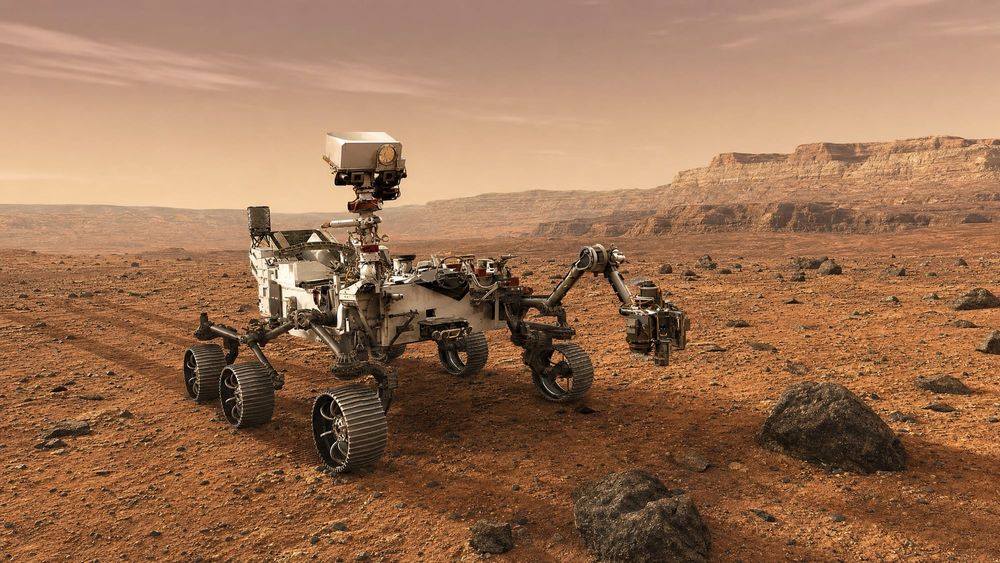
NASA's Perseverance rover has quietly become the most successful autonomous vehicle ever deployed, with approximately 90 percent of the total distance it has driven on Mars completed without human intervention, according to a report this week from Ars Technica. The rover, which landed in Jezero Crater in February 2021, uses its AutoNav system to independently plot safe paths across Martian terrain, dodging rocks, steep slopes, and sand traps without waiting for command sequences from Earth — where the one-way signal delay ranges from 4 to 24 minutes depending on planetary positions.
AutoNav represents a generational leap over earlier rover navigation. Spirit and Opportunity could manage roughly 100 meters per day with careful ground-controller planning, each drive requiring a full cycle of image downlink, path computation on Earth, command uplink, and cautious execution. Curiosity introduced limited autonomous capability. Perseverance changed the paradigm entirely: it can drive at speeds up to 120 meters per hour while processing stereo camera imagery to build real-time 3D terrain models, evaluating hazards across billions of possible path options, and selecting the optimal route — all while the rover is in motion. The system runs on a dedicated onboard computing unit that handles the navigation algorithm independently of the rover's science computer, allowing driving and science operations to occur in parallel.
The implications extend far beyond Jezero Crater. Any crewed Mars mission will depend on robotic systems that can operate independently for months or years before astronauts arrive — pre-positioning supplies, conducting reconnaissance, grading landing sites, and deploying habitation infrastructure. Perseverance's AutoNav performance provides the validation data that mission designers need to plan those operations with confidence. NASA's upcoming SkyFall Mars helicopter mission — three rotorcraft equipped with ground-penetrating radar and near-infrared instruments, wearing tiny protective capes during descent — will also draw on autonomous navigation lessons from Perseverance as it develops independent flight-planning capabilities for the thin Martian atmosphere.
THE DOUGH
Autonomous navigation technology developed for Mars has direct terrestrial applications in mining, agriculture, defense robotics, and autonomous vehicles. NASA's Jet Propulsion Laboratory, which built AutoNav, regularly transfers technology to commercial partners and licensees. The success also strengthens the business case for more ambitious robotic precursor missions that would prepare for human Mars exploration — creating procurement demand for spacecraft, instruments, communications systems, and ground infrastructure from companies across the space industrial base including Lockheed Martin, Northrop Grumman, and a growing ecosystem of Mars-focused startups.
We are not financial analysts or investment advisors. Nothing in this newsletter constitutes investment advice. All economic analysis is speculative and for informational purposes only. Do your own research.
THE POSSIBILITIES
If autonomous rovers can handle 90 percent of driving on Mars, the same capability applied to the Moon could dramatically accelerate surface base construction. Robots that navigate and build independently — without round-trip command delays — could assemble infrastructure months before astronauts arrive, transforming the economics and safety of human lunar exploration.
THE HURDLES
The remaining 10 percent of driving that still requires human oversight typically involves the most challenging terrain — areas where AutoNav's confidence drops below safety thresholds. Scaling autonomous capability to handle these edge cases is exponentially harder than the routine 90 percent, and any navigation failure on Mars could strand a multi-billion-dollar asset with no rescue option.
WHAT TO WATCH
- AutoNav performance data as Perseverance enters increasingly complex terrain near the Jezero Crater rim
- NASA SkyFall Mars helicopter mission development and autonomous flight-planning capabilities
- Mars Sample Return mission architecture and the role of autonomous surface systems
- JPL technology transfer to commercial autonomous vehicle and robotics companies
Void Economy is researched, written, and illustrated with AI, reviewed and edited by a real, live, flesh-n-blood human.