
THE STORY
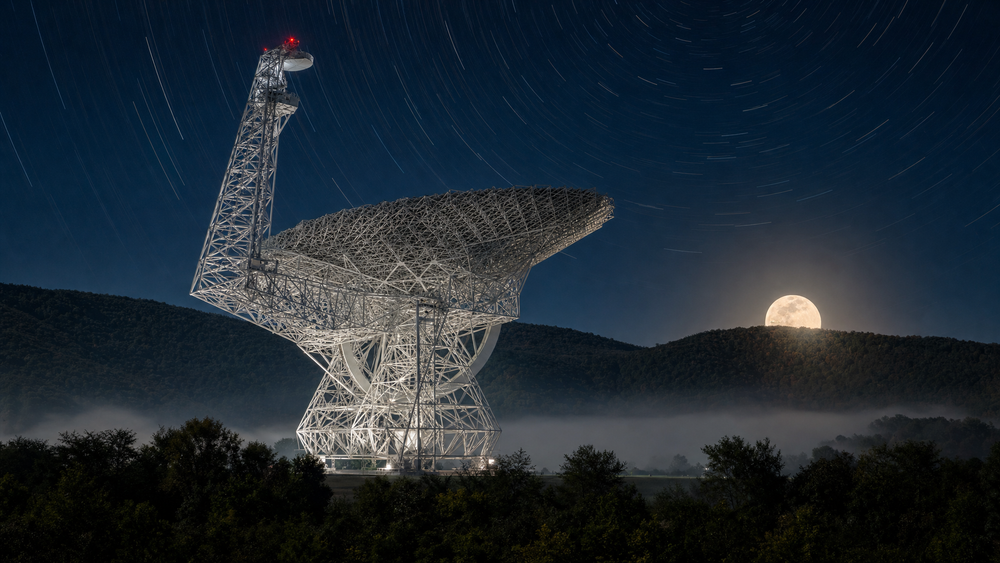
The Green Bank Telescope in West Virginia — one of the world's largest fully steerable radio telescopes — tracked NASA's Orion spacecraft throughout its five-day journey around the Moon during the Artemis II mission, gathering precise observations on the capsule's movements in cislunar space. The telescope's radar and radio-frequency capabilities allowed it to independently verify Orion's trajectory, complementing NASA's Deep Space Network tracking. Scientists noted that monitoring a crewed spacecraft at lunar distances with ground-based radio telescopes demonstrated capabilities that could support future cislunar traffic management as more nations and companies send vehicles to the Moon.
"There are 4 people in those pixels," one researcher noted — a quietly profound statement about humanity's return to deep space captured through a single dish in the Appalachian mountains.
THE DOUGH
As cislunar space becomes more congested with Artemis missions, commercial landers, and international programs, independent tracking capabilities will become essential. The Green Bank Telescope's demonstration validates ground-based radio observatories as viable cislunar surveillance assets — a role that could attract funding from both NASA and the Space Force. Companies building cislunar space situational awareness systems, like those competing for Andromeda contracts, may look to partner with or fund similar observatory capabilities.
We are not financial analysts or investment advisors. Nothing in this newsletter constitutes investment advice. All economic analysis is speculative and for informational purposes only. Do your own research.
THE POSSIBILITIES
Ground-based cislunar tracking could become the backbone of a "lunar air traffic control" system. As multiple nations and companies operate simultaneously around the Moon, someone will need to provide independent, trusted tracking — and that role may fall to observatories rather than any single nation's space agency.
THE HURDLES
The Green Bank Telescope faces ongoing funding uncertainty, and dedicating telescope time to spacecraft tracking competes with its primary radio astronomy mission. Scaling this capability to track dozens of cislunar objects simultaneously would require significant infrastructure investment.
WHAT TO WATCH
- NASA or Space Force contracts for ground-based cislunar tracking services
- Green Bank Telescope's role in future Artemis mission tracking
- International interest in shared cislunar space situational awareness