
THE STORY
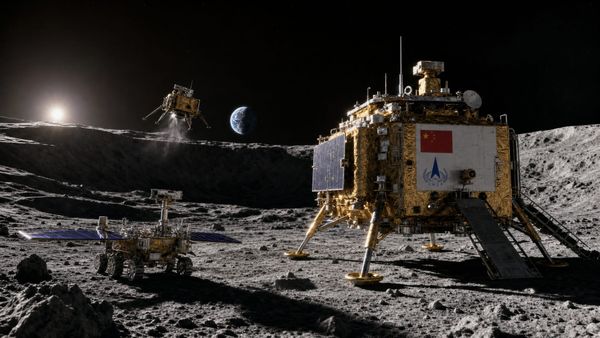
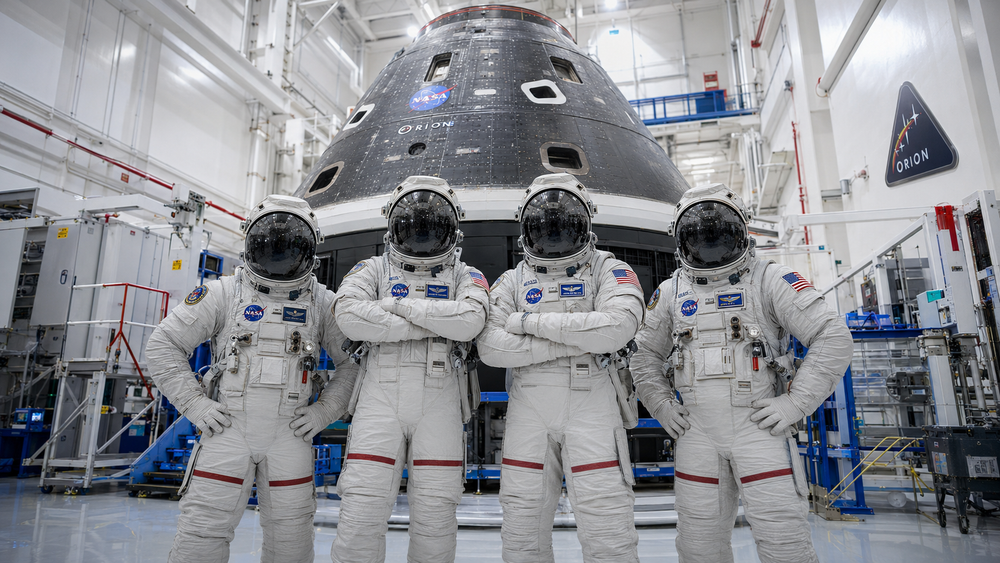
NASA just revealed the crew of Artemis III and laid out a mission architecture so ambitious it makes Apollo look straightforward. On June 9, NASA Administrator Jared Isaacman announced that astronauts Randy Bresnik, Andre Douglas, Frank Rubio, and ESA astronaut Luca Parmitano will fly to low Earth orbit in 2027 aboard the Orion spacecraft to test docking procedures with two entirely unflown lunar landers — SpaceX's Starship Human Landing System and Blue Origin's Blue Moon Mark 2. It is the first time an ESA astronaut has been assigned to an Artemis mission, a product of ongoing negotiations over Europe's expanded role in the lunar program.
The mission's complexity is staggering. Three separate heavy-lift launches are required: NASA's Space Launch System to send Orion to orbit, a SpaceX Starship to deliver its HLS variant, and a Blue Origin New Glenn to loft Blue Moon. Once on orbit, the Artemis III crew will attempt to rendezvous and dock with each lander prototype in sequence, validating the navigation, docking interfaces, life support crossover, and crew transfer procedures that must work flawlessly before anyone rides these vehicles to the lunar surface. NASA has described Artemis III as potentially "one of the most complex human spaceflight missions in recent history" — and the astronauts won't even leave Earth orbit.
The crew selection underscores the mission's stakes. Bresnik, a Marine aviator and veteran of two spaceflights including a 2017 ISS expedition, brings deep EVA experience. Rubio holds the American single-spaceflight endurance record at 371 days, giving the crew intimate knowledge of long-duration operations. Douglas, a Coast Guard rescue swimmer turned NASA astronaut, brings operational adaptability. Parmitano, a veteran of two ISS expeditions who commanded Expedition 61, adds international leadership depth. The commander told reporters he is "confident the crew will be ready" despite an aggressive one-year preparation timeline.
What makes this mission strategically critical is its dual-lander architecture. By testing both SpaceX's and Blue Origin's vehicles simultaneously, NASA creates competitive redundancy — if one lander encounters delays, the other path to the Moon remains viable. Neither lander has flown in its crew-rated configuration. SpaceX's HLS requires orbital refueling demonstrations that have yet to be attempted, while Blue Origin's Blue Moon Mark 2 is still under assembly. Artemis III in LEO is the gate that unlocks everything that follows: Artemis IV's crewed lunar landing in 2028, sustained surface operations, and eventually the infrastructure for a permanent Moon base. The revised mission architecture, forced in part by New Glenn's explosive debut reshaping NASA's planning, represents the agency's clearest path yet from Earth orbit to boots on regolith.
THE DOUGH
Artemis III validates parallel investments in both SpaceX (Starship HLS) and Blue Origin (Blue Moon), while extending revenue pipelines for Lockheed Martin (Orion), Northrop Grumman (SLS boosters), and the European industrial base contributing to ESA's expanded role. Success would accelerate follow-on Artemis contracts and commercial lunar services for companies like Intuitive Machines, Firefly Aerospace, and Astrobotic. The dual-lander architecture also signals that NASA intends to sustain competitive procurement deep into the 2030s, providing long-term revenue visibility for both prime contractors and their sprawling supplier networks.
We are not financial analysts or investment advisors. Nothing in this newsletter constitutes investment advice. All economic analysis is speculative and for informational purposes only. Do your own research.
THE POSSIBILITIES
The most significant detail isn't the crew — it's Parmitano. His assignment signals that ESA is negotiating for European astronauts to eventually walk on the Moon, a diplomatic outcome that would permanently bind transatlantic space cooperation and create an irreversible political constituency for Artemis funding across two continents.
THE HURDLES
Neither lander has flown crew-rated. SpaceX's Starship HLS requires successful orbital refueling — something never demonstrated — and Blue Origin must complete assembly and testing of Blue Moon Mark 2 on a vehicle (New Glenn) with only a handful of flights. Coordinating three independent heavy-lift launches within a tight window introduces cascading schedule risk.
WHAT TO WATCH
- SpaceX orbital refueling demonstration timeline — the single biggest Artemis dependency
- Blue Origin's Blue Moon Mark 2 hardware milestones and New Glenn flight cadence
- ESA's formal agreement on European astronaut roles for Artemis IV and beyond
- SLS booster segment delivery to Kennedy Space Center and integration schedule
- Whether NASA inserts additional precursor flights if either lander encounters delays