

THE STORY
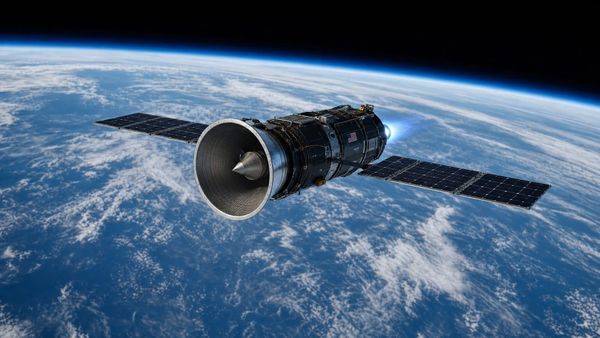
The European Commission has reached an agreement with an industrial consortium led by satellite operators SES and Eutelsat to proceed with an expanded version of IRIS² — the Infrastructure for Resilience, Interconnectivity and Security by Satellite — Europe's sovereign answer to Starlink and growing dependence on non-European space-based communications. The updated plan increases both the number of satellites and the program's overall cost, while the EU has accelerated the service launch date by one year to 2029, citing a "changing security environment" that demands greater communications capacity and strategic autonomy.
SES announced the successful completion of Rendez-vous 1 (RDV1), a key implementation-phase milestone, while finalizing capital commitments for its Medium Earth Orbit satellite fleet. Separately, Indra Sistemas' satellite subsidiary Hispasat won a role as primary contractor on a services package valued at over €1.6 billion ($1.8 billion), reinforcing the program's commitment to European industrial participation across the supply chain. The constellation will provide secure government communications, broadband connectivity for underserved European regions, and backup for critical infrastructure — functions the EU has determined cannot be left dependent on American or non-European operators, particularly as geopolitical tensions intensify.
The expansion comes as European defense spending accelerates and the ongoing Iran conflict exposes vulnerabilities in terrestrial communications infrastructure. The European Space Policy Institute recently warned that Europe risks becoming dependent on foreign orbital computing infrastructure, and IRIS² is the bloc's most concrete response to that concern. By building a sovereign constellation under European industry leadership, the EU aims to maintain strategic autonomy in space-based communications — even if that means paying significantly more and deploying more satellites than originally budgeted. The question is whether European industrial coordination, historically prone to delays and cost overruns, can deliver at a pace competitive with SpaceX's Starlink, which already blankets the globe, and Amazon's Kuiper, which is approaching commercial launch.
THE DOUGH
IRIS² represents one of the largest European space programs in a decade, generating sustained contracts for Airbus Defence and Space, Thales Alenia Space, OHB, and dozens of smaller European satellite manufacturers and component suppliers. SES and Eutelsat are the primary commercial operators positioned to benefit. The schedule acceleration to 2029 increases near-term industrial spending, benefiting Europe's space sector workforce at a time when national budgets are being redirected toward defense. For investors, European defense and aerospace holdings — including direct positions in SES, Eutelsat, Airbus, and Thales — gain multi-year revenue visibility from a sovereign program with strong political backing.
We are not financial analysts or investment advisors. Nothing in this newsletter constitutes investment advice. All economic analysis is speculative and for informational purposes only. Do your own research.
THE POSSIBILITIES
IRIS² could become Europe's dual-use communications backbone — a government-funded constellation that eventually offers commercial broadband services, generating revenue to offset public investment and reducing European reliance on non-EU satellite operators for both civilian and military connectivity.
THE HURDLES
European multi-nation space programs have a long history of cost overruns, schedule delays, and the complexity of juste retour industrial coordination. IRIS² must compete for customers against Starlink's already-global service and Amazon Kuiper's upcoming network, both of which benefit from simpler organizational structures, deeper pockets, and more aggressive deployment timelines.
WHAT TO WATCH
- IRIS² satellite manufacturing contract awards and production facility timelines
- EU defense budget increases and their impact on constellation requirements
- SES and Eutelsat financial disclosures on IRIS² capital commitments and revenue projections
- Interoperability planning with NATO military communications networks
Void Economy is researched, written, and illustrated with AI, reviewed and edited by a real, live, flesh-n-blood human.