
THE STORY
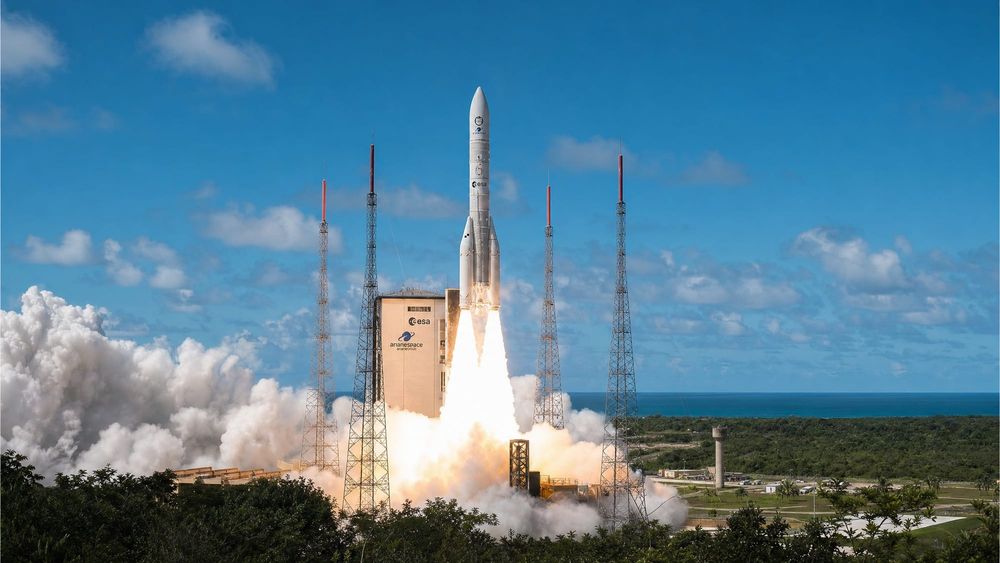
Arianespace successfully launched the Meteosat Third Generation Imager 2 (MTG-I2) weather satellite aboard an Ariane 62 rocket from Europe's Spaceport in Kourou, French Guiana, on August 27, completing the imaging backbone of Europe's most advanced meteorological satellite system. Built by prime contractor Thales Alenia Space, MTG-I2 joins its twin MTG-I1 — launched in December 2022 — in geostationary orbit, where the pair will provide continuous, high-resolution imagery of weather patterns across Europe, Africa, and the Atlantic from an altitude of 36,000 kilometers.
The MTG constellation represents a generational leap over the previous Meteosat Second Generation system that has served European weather forecasting since 2004. The new imagers carry the Flexible Combined Imager (FCI), which can scan the full Earth disk every ten minutes at resolutions as fine as 500 meters in visible channels — roughly four times the resolution of its predecessors. The system also features a Lightning Imager capable of detecting individual lightning flashes in real time from geostationary orbit, a capability critical for severe storm tracking and aviation safety. EUMETSAT, the European meteorological agency, confirmed post-launch that MTG-I2 had separated successfully and was responding to commands.
The launch also marks a milestone for Ariane 6 itself. Europe's newest heavy launcher, which flew its inaugural mission in July 2024 after years of delays, is gradually building its flight manifest and demonstrating the reliability needed to win commercial and institutional confidence. The Ariane 62 variant used for this mission — featuring two solid rocket strap-on boosters — is the lighter configuration designed for medium-weight payloads to geostationary transfer orbit. The successful MTG-I2 delivery adds a data point to Ariane 6's still-short flight record and reinforces its role as the workhorse for European institutional missions.
With the MTG imaging constellation now complete, EUMETSAT's focus shifts to the sounding satellites — MTG-S1 and MTG-S2 — which will carry infrared sounders for atmospheric profiling and composition monitoring. The full MTG system, when operational, will provide European forecasters with an unprecedented combination of high-resolution imagery, lightning detection, and atmospheric sounding data, significantly improving severe weather prediction, climate monitoring, and aviation safety across the continent and beyond.
THE DOUGH
The MTG program represents billions of euros in contracts for Thales Alenia Space (prime contractor), Airbus Defence and Space, OHB, and dozens of European subcontractors. Arianespace secures its role as the launch provider for EUMETSAT's flagship missions, reinforcing the institutional customer base that underpins Ariane 6's business case. Downstream, improved weather data from MTG feeds into commercial weather services, agricultural forecasting, insurance risk modeling, and renewable energy grid management — industries that collectively represent hundreds of billions in economic value dependent on accurate meteorological data.
We are not financial analysts or investment advisors. Nothing in this newsletter constitutes investment advice. All economic analysis is speculative and for informational purposes only. Do your own research.
THE POSSIBILITIES
MTG's Lightning Imager is one of the first instruments capable of real-time lightning detection from geostationary orbit over Europe and Africa. If the data proves operationally valuable for aviation rerouting and severe-storm nowcasting, it could become a template for similar instruments on next-generation NOAA and JMA weather satellites — potentially creating a global lightning-monitoring network that dramatically improves flight safety and storm-damage prediction.
THE HURDLES
Ariane 6's flight cadence remains low compared to competitors, and each mission still carries outsized significance for demonstrating the vehicle's reliability. Any anomaly on a future Ariane 6 flight could delay the remaining MTG sounding-satellite launches and undermine confidence in Europe's ability to maintain assured access to space for critical weather infrastructure.
WHAT TO WATCH
- MTG-I2 commissioning timeline and first operational imagery delivery to EUMETSAT
- Ariane 6 launch cadence through end of 2026 and into 2027
- MTG-S1 sounding satellite launch date and integration status
- Whether the Lightning Imager data meets operational requirements for aviation and severe weather services
Void Economy is researched, written, and illustrated with AI, reviewed and edited by a real, live, flesh-n-blood human.