
THE STORY
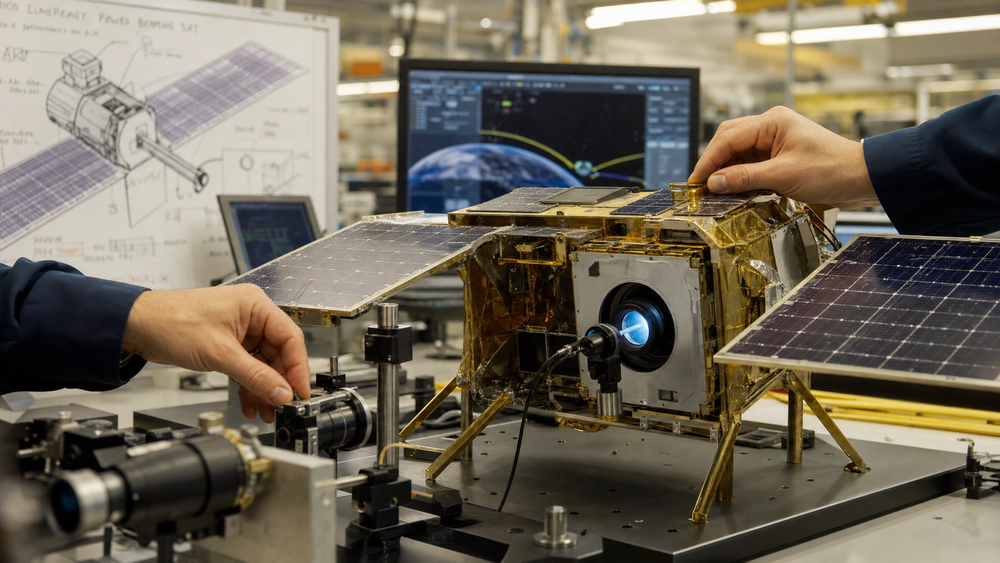
Star Catcher Industries, led by former Made in Space and Redwire executive Andrew Rush, has closed a $65 million Series A round led by B Capital, co-led by Shield Capital and Cerberus Ventures, to develop what the company calls the world's first power grid in space. Star Catcher's approach uses a constellation of satellites equipped with high-powered lasers to beam energy to other spacecraft in orbit. The concept addresses one of the most fundamental constraints in space operations: every satellite, station, and vehicle currently must carry its own power generation system, limiting capability and driving up mass and cost.
If Star Catcher can validate laser power beaming at orbital distances, it would decouple power generation from the spacecraft that need it. Satellites could be designed smaller and lighter, deep-space missions could receive power boosts en route, and orbital infrastructure like space stations or manufacturing platforms could draw from a shared power utility rather than deploying enormous solar arrays.
THE DOUGH
The space power market barely exists today, which is exactly what makes it interesting. Every satellite operator currently builds power systems into their spacecraft — solar arrays, batteries, occasionally radioisotope generators. A shared power utility in orbit could fundamentally change spacecraft design economics, reducing mass and cost while enabling missions that are currently power-limited. Defense applications are immediate: the Pentagon's proliferated LEO architecture and the Golden Dome program both require sustained power for sensors and interceptors that could benefit from external power beaming. Star Catcher's investor lineup — B Capital (an enterprise-tech focused fund), Shield Capital (defense-tech), and Cerberus Ventures — suggests the company is targeting both commercial and military customers from day one.
We are not financial analysts or investment advisors. Nothing in this newsletter constitutes investment advice. All economic analysis is speculative and for informational purposes only. Do your own research.
THE POSSIBILITIES
The real play may not be satellite-to-satellite power beaming — it's what happens when the technology matures enough to beam power from orbit to ground. A space-based solar power system that collects energy 24/7 in orbit (no clouds, no night) and beams it down via laser or microwave could eventually compete with terrestrial renewables for baseload power. Star Catcher's orbital demonstrations would be the proof-of-concept for that multi-trillion-dollar market.
THE HURDLES
Laser power beaming over orbital distances is extraordinarily difficult. Atmospheric absorption, beam divergence, and precise pointing requirements at thousands of kilometers create engineering challenges that no one has solved at scale. The energy conversion efficiency from laser to usable electrical power on the receiving spacecraft needs to be high enough to justify the infrastructure cost. And any system that beams high-powered lasers through space raises serious dual-use and space safety concerns that regulators will scrutinize intensely.
WHAT TO WATCH
- Star Catcher's timeline for an on-orbit technology demonstration
- Pentagon interest — any DARPA or Space Force contracts for power-beaming validation
- Competing approaches from companies like Solaris (ESA-backed space solar power)
- Laser power beaming efficiency benchmarks from ground-based tests
- Whether orbital data center companies (Cowboy Space, others) emerge as early customers