
THE STORY
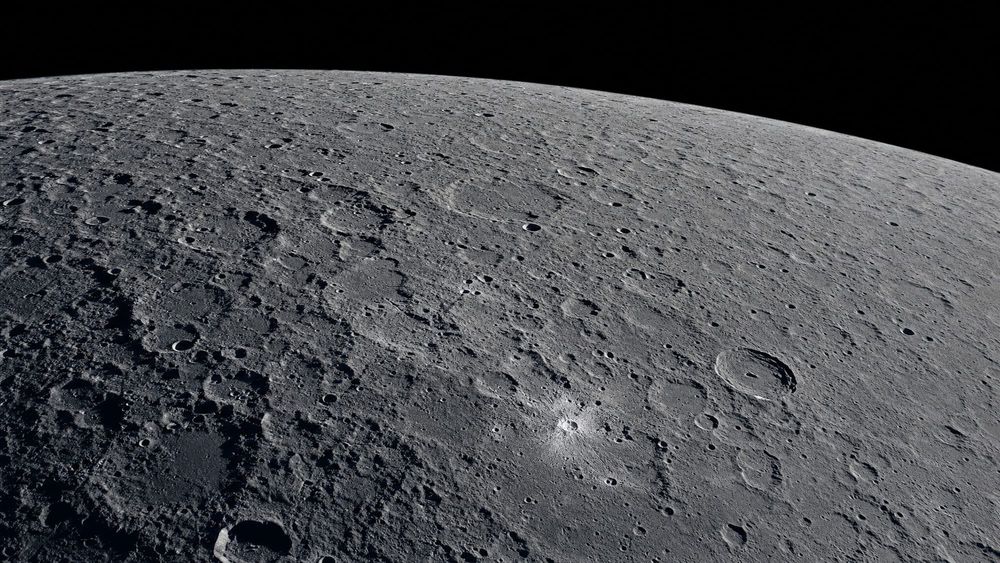
On August 5, 2026, a spent SpaceX Falcon 9 upper stage — a 4-metric-ton, 12-meter-long aluminum cylinder left over from a 2025 commercial lunar lander mission — slammed into the Moon near the Einstein and Bell craters at approximately 2.6 kilometers per second. South Korea's Danuri lunar orbiter captured before-and-after images of the impact site within days, revealing a small but distinct fresh crater blasted into the regolith, with characteristic ray patterns of ejected material radiating outward from the central depression. NASA scientists had been tracking the incoming stage with ground-based telescopes and coordinated with SpaceX to treat the event as an impromptu science opportunity.
The collision was unintentional but not unprecedented. Falcon 9 upper stages from missions to high Earth orbit or cislunar space often lack sufficient residual propellant to deorbit safely into Earth's atmosphere. Instead, they enter chaotic, long-duration orbits that are gravitationally perturbed by the Earth, Moon, and Sun over months or years — trajectories that can evolve unpredictably to intersect the lunar surface. This particular stage had been drifting since its 2025 launch, and trajectory analysts identified the collision course with enough advance notice for observation planning. The Korea Aerospace Research Institute shared the resulting imagery, showing the gash was relatively modest — consistent with the moderate mass and velocity of the impactor compared to, say, an asteroid strike.
NASA and SpaceX announced they are jointly studying ways to prevent future uncontrolled collisions, an acknowledgment that the stakes are rising as lunar activity accelerates. This was not the first rocket stage to hit the Moon — a Chinese Long March 5B booster struck the far side in 2022, and Apollo-era S-IVB stages were intentionally crashed to provide seismic data. But as Artemis, commercial landers, and international lunar missions proliferate, the frequency of uncontrolled impacts will increase. With surface instruments, infrastructure, and eventually human habitation planned near the lunar poles, space debris management is no longer just a Low Earth Orbit problem — it's a cislunar imperative.
THE DOUGH
The incident highlights the nascent market for cislunar space situational awareness — tracking and managing objects in the vast volume between Earth and Moon. Companies like LeoLabs, ExoAnalytic Solutions, and AGI are developing capabilities in this space, and government investment in cislunar tracking is growing. As the number of missions to the Moon accelerates under Artemis, commercial lunar programs, and international efforts, the demand for a cislunar traffic management system becomes urgent — a market that barely existed five years ago but could grow rapidly in the coming decade.
We are not financial analysts or investment advisors. Nothing in this newsletter constitutes investment advice. All economic analysis is speculative and for informational purposes only. Do your own research.
THE POSSIBILITIES
Controlled rocket-stage impacts could become a deliberate scientific tool. The seismic energy from an impact can be measured by surface instruments to probe the Moon's internal structure, just as Apollo-era stage crashes were used for seismology. As lunar seismometer networks expand with upcoming commercial lander missions, intentionally targeting spent stages at specific locations could become a low-cost geophysics program.
THE HURDLES
No international framework exists for managing debris in cislunar space. The Outer Space Treaty assigns liability for damage caused by space objects, but enforcement mechanisms are weak and determining intent versus negligence is legally murky. As more nations and companies operate around the Moon, the risk of an uncontrolled impact damaging a surface asset — or worse, a crewed installation — grows with every mission.
WHAT TO WATCH
- Higher-resolution Danuri imagery of the impact crater for detailed scientific analysis
- NASA-SpaceX joint recommendations for preventing future uncontrolled lunar impacts
- International discussions on cislunar debris management frameworks
- Deployment of seismometers on upcoming commercial lunar lander missions
Void Economy is researched, written, and illustrated with AI, reviewed and edited by a real, live, flesh-n-blood human.