
THE STORY
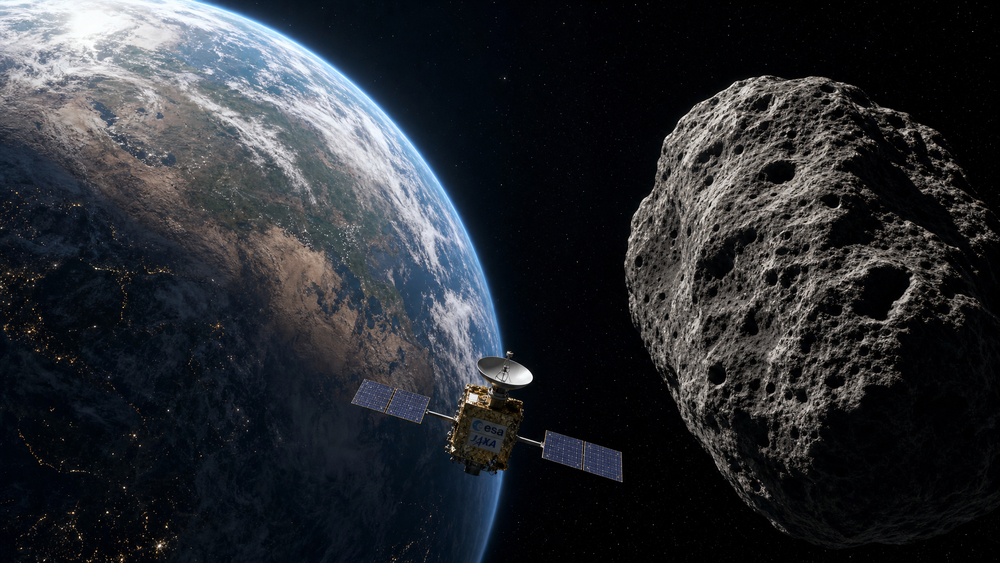
The European Space Agency and the Japan Aerospace Exploration Agency have finalized a formal agreement to collaborate on a joint mission to study the asteroid Apophis during its extraordinarily close flyby of Earth in April 2029. Apophis, roughly 370 meters across, will pass within approximately 31,000 kilometers of Earth's surface — closer than geostationary communications satellites. The agreement builds on ESA's Ramses rapid-response mission concept and JAXA's expertise from the Hayabusa asteroid sample-return program. The 2029 encounter is a once-in-a-millennia event: an asteroid of this size passing this close is vanishingly rare, and having advance notice makes it an unprecedented scientific opportunity.
The joint mission will study how Earth's gravity alters Apophis's spin, shape, and orbital trajectory in real time — data critical for planetary defense. If humanity ever needs to deflect a threatening asteroid, understanding how gravitational encounters reshape these bodies is foundational knowledge that cannot be obtained any other way.
THE DOUGH
Planetary defense is transitioning from theoretical research to an operational capability with dedicated funding streams. NASA's DART mission demonstrated kinetic deflection; now ESA-JAXA's Apophis collaboration extends the science into close-encounter dynamics. Companies involved in deep-space mission hardware — including OHB, Airbus Defence and Space, and NEC — stand to benefit from mission procurement. The broader planetary defense market, while small today, could expand significantly if Apophis observations reveal new risks or if governments establish standing deflection programs.
We are not financial analysts or investment advisors. Nothing in this newsletter constitutes investment advice. All economic analysis is speculative and for informational purposes only. Do your own research.
THE POSSIBILITIES
The Apophis encounter isn't just about one asteroid — it's a dry run for humanity's planetary defense infrastructure. If ESA and JAXA can deploy spacecraft to rendezvous with a fast-approaching object on a known timeline, it demonstrates the kind of rapid mission architecture needed for genuine threat response. The data from 2029 could reshape how every spacefaring nation budgets for asteroid defense.
THE HURDLES
The 2029 window is fixed by celestial mechanics, meaning any development delays translate directly into missed science. International collaboration adds coordination complexity, and both agencies face budget pressures that could affect mission scope. ESA's Ramses mission needs to be built, tested, and launched on a compressed timeline to arrive at Apophis before the flyby.
WHAT TO WATCH
- ESA Ramses mission prime contractor selection and development timeline
- JAXA's specific spacecraft contribution and instrument package
- NASA involvement via any complementary observation missions
- Whether the encounter reveals unexpected tidal deformation in Apophis