THE STORY
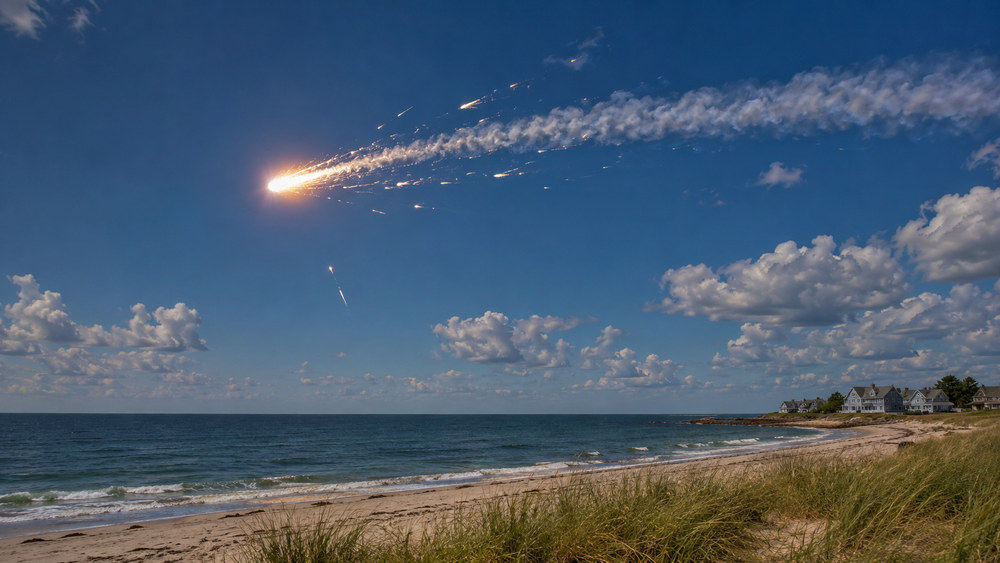
At approximately 2:06 PM ET on Saturday, May 31, a meteor streaked over the northeastern United States and detonated north of Cape Cod Bay in a blast powerful enough to shake houses, rattle windows, and trigger a wave of emergency calls from startled residents across Massachusetts. The fireball was captured on camera by numerous witnesses, appeared clearly in satellite imagery lighting up the daytime sky, and produced a sonic boom that many initially mistook for an explosion or earthquake. NASA subsequently confirmed the event as a bolide — a meteor that explodes in the atmosphere before reaching the ground.
Bolide events of this magnitude over populated areas are relatively rare. The object — likely a small asteroid fragment measuring a few feet in diameter — entered the atmosphere at speeds estimated near 40,000 miles per hour, compressing the air ahead of it into a superheated plasma sheath reaching temperatures of several thousand degrees. When the structural stresses exceeded the rock's tensile strength, it fragmented explosively at altitude, converting its kinetic energy into a shockwave that propagated to the surface as the sonic boom residents reported. The brightness of the flash and its visibility in satellite data suggest an energy release in the range of tens to hundreds of tons of TNT — far smaller than the 2013 Chelyabinsk event in Russia, but still remarkable for the densely populated Eastern Seaboard. No meteorite fragments have been confirmed recovered, though the trajectory suggests any surviving material would have fallen into Cape Cod Bay waters.
Events like this underscore the continued relevance of planetary defense investment. NASA's Planetary Defense Coordination Office tracks near-Earth objects larger than roughly 140 meters — objects capable of regional devastation — but smaller bolides like the Cape Cod event are essentially undetectable before atmospheric entry. They arrive without warning and, in rare cases, can cause injuries, as Chelyabinsk demonstrated when more than 1,500 people were hurt primarily by shattered glass. The Cape Cod bolide also showcased the growing power of ubiquitous monitoring: the event was characterized within hours using social media footage, weather satellite data, and seismic networks — a speed of analysis impossible a decade ago. For planetary defense researchers, every bolide is both a free data point and a reminder of how much of the near-Earth environment remains unmapped.
THE DOUGH
While individual meteor events carry no direct investment implications, the Cape Cod bolide reinforces the case for expanded planetary defense funding — a market that benefits companies like Lockheed Martin, which built NASA's DART asteroid deflection spacecraft, and the growing ecosystem of commercial space surveillance firms. The event also highlights the value of commercial Earth observation networks and rapid event characterization services, a niche that companies like LeoLabs and ExoAnalytic Solutions are expanding into.
We are not financial analysts or investment advisors. Nothing in this newsletter constitutes investment advice. All economic analysis is speculative and for informational purposes only. Do your own research.
THE POSSIBILITIES
The real lesson isn't the rock that exploded — it's the detection gap. Objects in this size range arrive without warning because they're too small and dark for current survey telescopes to spot before atmospheric entry. The companies that can provide sub-hour event characterization from space, rather than relying on ground-based cameras and social media, will fill a niche that planetary defense agencies increasingly recognize they need.
THE HURDLES
Planetary defense funding remains a small fraction of NASA's budget, and political will to expand it tends to spike only after dramatic events. The Cape Cod bolide caused no injuries or property damage, which paradoxically makes it less likely to drive policy action despite demonstrating a genuine detection vulnerability.
WHAT TO WATCH
- Search efforts for meteorite fragments in the Cape Cod Bay area
- Whether NASA's Planetary Defense Coordination Office issues updated assessments of small-object detection gaps
- Progress on the NEO Surveyor space telescope, designed to catalog near-Earth objects
- Commercial firms developing rapid-response bolide characterization capabilities from orbit