THE STORY
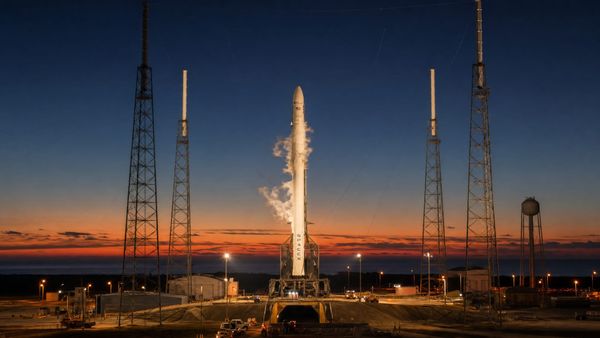
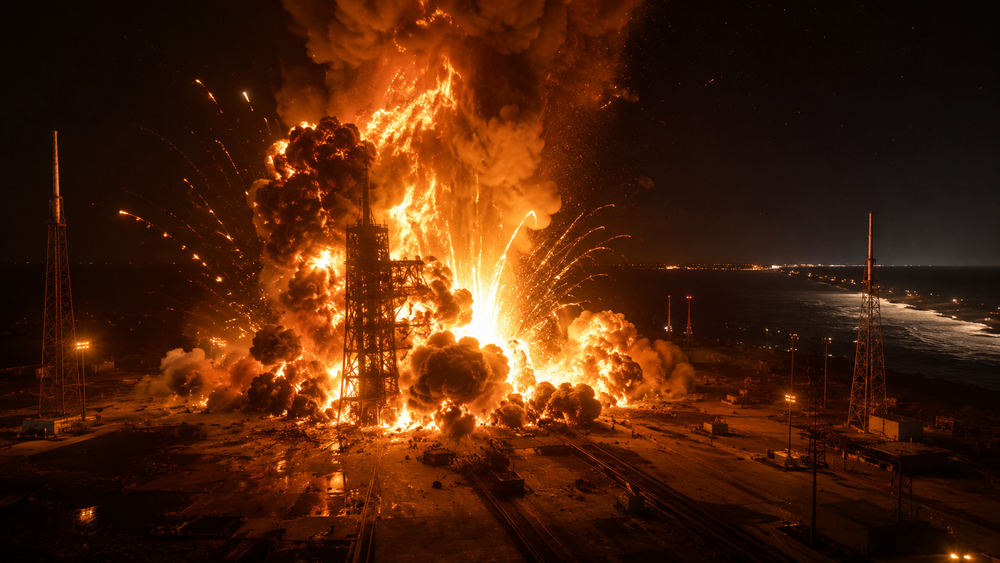
Blue Origin's New Glenn rocket — the heavy-lift vehicle Jeff Bezos has spent over a decade and billions of dollars developing to challenge SpaceX's dominance — exploded during a static fire test at Cape Canaveral on the evening of May 28, creating a fireball visible from hundreds of miles across Florida. The detonation at Launch Complex 36 destroyed the rocket entirely and inflicted extensive damage to the pad infrastructure, scattering debris so far that Space Force officials warned beachgoers about wreckage potentially washing ashore along the coast. Bezos acknowledged the failure on social media, calling it "a very rough day" and noting it was "too early to know the root cause." In a grim twist of timing, Blue Origin had received a national security launch task order from the U.S. Space Force and National Reconnaissance Office just hours before the explosion — both agencies issued statements saying they "remain committed partners with Blue Origin."
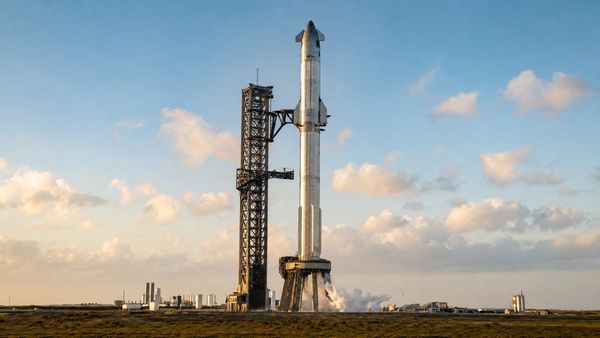
New Glenn is a 320-foot, two-stage rocket powered by seven BE-4 liquid methane-liquid oxygen engines on its first stage, each producing roughly 550,000 pounds of thrust. The vehicle was designed from the outset for first-stage reusability — a capability Blue Origin had not yet successfully demonstrated in flight. This was the fourth New Glenn vehicle built, and it was being prepared for an Amazon Leo satellite delivery mission targeted for as soon as June 4. Ars Technica called it "the most spectacular rocket explosion since N1" — referencing the Soviet moon rocket that famously destroyed its own launch pad in 1969. The comparison is apt: LC-36 will require significant reconstruction before any New Glenn can fly from the site again, and Blue Origin has no backup launch pad for the vehicle. Analysts estimate months of delays at minimum.
The implications cascade across the entire space industry. Amazon's Project Kuiper broadband constellation — a $10-billion-plus answer to Starlink — had booked multiple New Glenn flights and now faces acute launch provider uncertainty. NASA's Artemis program takes a direct hit as well: Blue Origin's Blue Moon Mark 2 cargo lander, assigned to the Artemis V mission, was designed to fly on New Glenn. Any delay to the rocket's return-to-flight timeline compounds schedule pressure on an agency already navigating Starship development hurdles. Space-related stocks pulled back sharply on Friday, with AST SpaceMobile and Rocket Lab both tumbling as investors reassessed sector risk. The Space Force and NRO issued a joint statement affirming their partnership, but Blue Origin's competitive position relative to SpaceX — which launched its 50th Starlink mission of 2026 the same week — has never looked more precarious.
THE DOUGH
The explosion has immediate ramifications for Amazon's Kuiper constellation timeline and could redirect launch contracts toward SpaceX and ULA, further concentrating market power in those providers. Blue Origin's nascent national security launch business — which was just beginning to gain traction — now faces credibility questions that could slow procurement. Defense primes like Northrop Grumman and Lockheed Martin, which build competing launch and satellite systems, may benefit from redirected contracts, while companies throughout the satellite broadband and lunar services supply chains face delays tied to New Glenn's grounding.
We are not financial analysts or investment advisors. Nothing in this newsletter constitutes investment advice. All economic analysis is speculative and for informational purposes only. Do your own research.
THE POSSIBILITIES
The deeper strategic consequence is what this does to launch competition. With ULA's Vulcan still working through certification and Blue Origin now sidelined, SpaceX's monopoly on heavy-lift commercial and national security launch tightens further — precisely as the company heads into the most scrutinized IPO in history. That monopoly power is worth more to SpaceX's valuation than any single rocket test.
THE HURDLES
Blue Origin must determine whether the failure originated in the BE-4 engines — which also power ULA's Vulcan rocket — or in ground support equipment and propellant systems. If the BE-4 is implicated, the ripple effects extend beyond Blue Origin to ULA's entire manifest, potentially creating a dual-vehicle grounding scenario the industry hasn't faced before.
WHAT TO WATCH
- Blue Origin's root-cause investigation findings and whether the BE-4 engine is implicated
- Timeline for LC-36 pad reconstruction at Cape Canaveral
- Amazon Kuiper's response — whether it redirects missions to SpaceX or other providers
- Impact on Blue Origin's Blue Moon lander schedule for NASA Artemis V
- Whether ULA issues statements or takes precautionary actions regarding shared BE-4 engine technology