
THE STORY
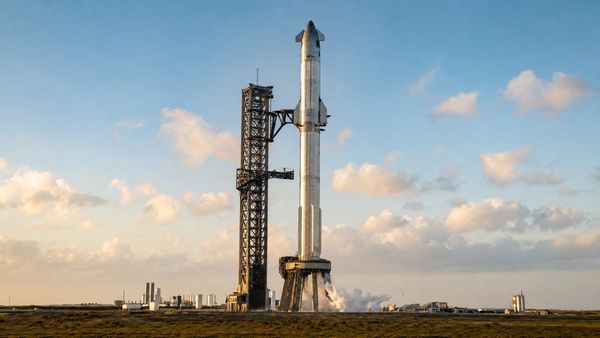
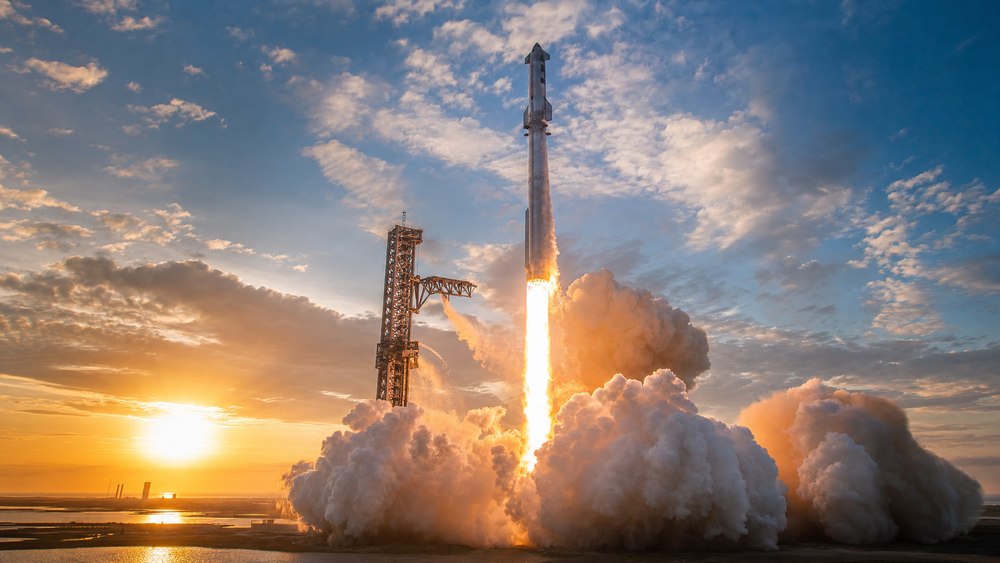
On May 22, 2026, SpaceX launched Starship Flight 12 from Pad 2 at Starbase, Texas — the debut flight of the third-generation Starship, the most powerful launch vehicle ever constructed. The upgraded Ship 39 was equipped with six third-generation Raptor engines, one of which shut down early during ascent. The flight computer compensated by running the remaining five engines longer than planned, placing the vehicle on an acceptable sub-orbital trajectory. Starship V3 reached space, survived reentry largely intact, and successfully deployed 20 dummy Starlink satellites — the first time a Starship has demonstrated payload deployment. The Super Heavy Booster 19, carrying a full complement of 33 Raptor engines, performed nominally during ascent but spun out of control during its return attempt and broke apart over the Gulf of Mexico. SpaceX CEO Elon Musk called the flight "epic." The launch came just two days after SpaceX publicly filed its S-1 prospectus for the largest IPO in history.
Starship V3 is the variant that underpins virtually everything SpaceX is betting its future on — from NASA's Human Landing System for Artemis to orbital refueling depots, orbital data centers, and Mars transit vehicles. Demonstrating that the upgraded ship can reach space, handle an engine-out scenario, deploy payloads, and survive reentry on its very first flight is an extraordinary engineering result, even with the loss of the booster.
THE DOUGH
SpaceX's IPO filing, made public days before the launch, revealed the company has already sunk more than $15 billion into Starship development. The S-1 disclosed $18.67 billion in 2025 revenue but a $4.28 billion net loss — driven largely by xAI investments. A successful V3 flight trajectory validates the core technical assumptions behind the company's $1.75–2 trillion IPO valuation, particularly its pitch to investors around orbital data centers and the $28.5 trillion total addressable market SpaceX claims to have identified. For the broader space economy, every company planning to launch large payloads — from Vast to Axiom to the U.S. Space Force — needs Starship's cost-per-kilogram economics to work.
We are not financial analysts or investment advisors. Nothing in this newsletter constitutes investment advice. All economic analysis is speculative and for informational purposes only. Do your own research.
THE POSSIBILITIES
The engine-out scenario may be the most valuable data point from the entire flight. Demonstrating that V3's flight computer can autonomously compensate for a failed engine and still complete its mission profile is precisely the kind of fault tolerance NASA needs to see before certifying Starship HLS for crewed lunar landings. This single flight may have done more to advance the Artemis III timeline than months of paperwork.
THE HURDLES
The booster is still a problem. Losing Super Heavy on return means SpaceX hasn't yet demonstrated the full rapid reusability cycle that makes Starship's economics revolutionary rather than merely impressive. The FAA also needs to clear the next flight license, and any anomaly investigation could introduce delays at a moment when IPO optics matter enormously.
WHAT TO WATCH
- Root cause analysis of the Booster 19 return failure and timeline to next flight
- Whether SpaceX attempts a booster catch on the next Starship V3 mission
- FAA license turnaround time for Flight 13
- NASA's assessment of V3 performance relative to HLS certification milestones
- SpaceX's first orbital refueling demonstration timeline