
THE STORY
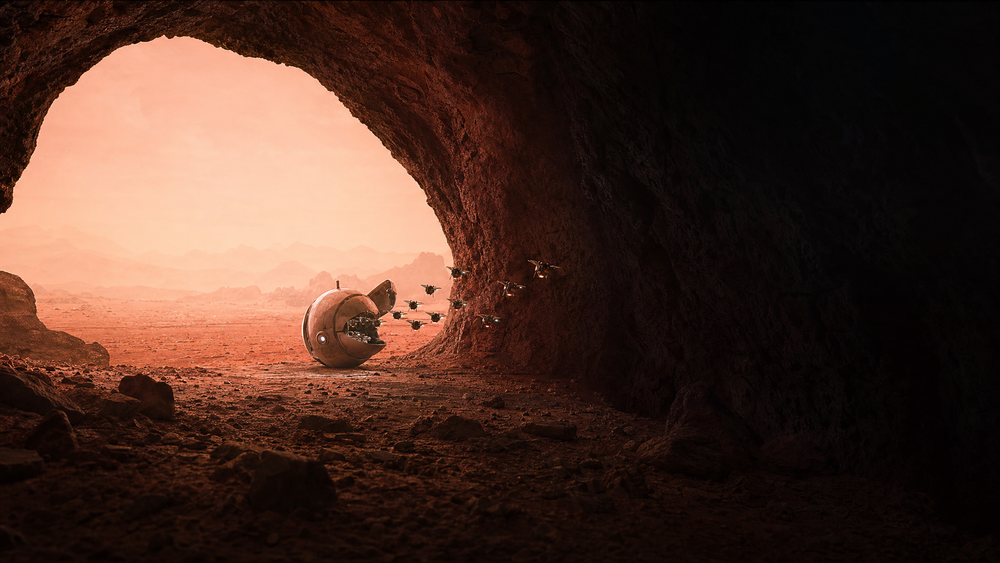
Engineers are developing a concept for a spherical, rolling robot that would carry a swarm of tiny "dandelion drones" to investigate lava tubes and other hidden tunnels on Mars. The design draws on "biomimicry" — taking inspiration from biological systems to solve engineering challenges in environments where traditional rovers can't operate. The roly-poly outer shell would roll across Martian terrain until it reaches a cave entrance, then release its payload of lightweight drones that would flutter into the darkness to map the interior. Mars lava tubes are of intense scientific interest because they could shelter future human habitats from radiation and micrometeorite impacts, and may preserve evidence of past microbial life in protected environments.
The concept represents a new paradigm for planetary exploration — deploying expendable micro-scouts from a mothership rather than sending a single, expensive rover into dangerous terrain. If the dandelion drones can navigate and map autonomously in GPS-denied, communication-limited cave environments, the approach could be applied to lunar lava tubes, ice caves on Europa, and other subterranean targets across the solar system.
THE DOUGH
NASA's interest in cave and lava tube exploration feeds directly into the Artemis program's long-term lunar habitation goals, where lava tubes on the Moon could serve as natural shelters for permanent bases. Companies developing swarm robotics, autonomous navigation in GPS-denied environments, and miniaturized sensor systems could see demand from both planetary science and defense applications. The biomimicry approach also has crossover potential for terrestrial search-and-rescue and infrastructure inspection markets.
We are not financial analysts or investment advisors. Nothing in this newsletter constitutes investment advice. All economic analysis is speculative and for informational purposes only. Do your own research.
THE POSSIBILITIES
If lava tubes on Mars are as extensive as geological models suggest — some could be hundreds of meters wide — they might represent the most habitable environments on the planet. A swarm-based exploration approach could map these tubes years before any crewed mission arrives, fundamentally shaping where humanity's first Martian settlements are built.
THE HURDLES
Flying anything on Mars is extraordinarily difficult — the atmosphere is less than 1% as dense as Earth's, which is why Ingenuity's rotors had to spin at 2,500 RPM. Dandelion-scale drones would need even more extreme engineering solutions to achieve flight in Martian conditions, and autonomy in pitch-dark cave environments without GPS or communication relay adds layers of complexity.
WHAT TO WATCH
- NASA funding decisions for lava tube exploration technology development
- Earth-based analog testing of swarm cave-exploration systems
- Progress on miniaturized autonomous navigation for GPS-denied environments