
THE STORY
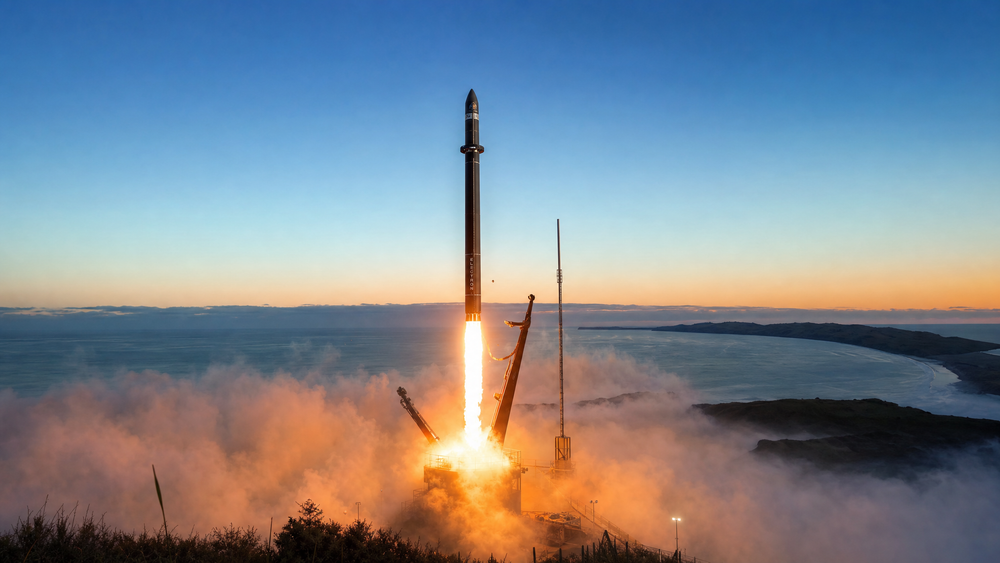
Rocket Lab secured a $90 million contract from the U.S. Space Force to build and operate two geostationary orbit satellites carrying optical payloads for a space domain awareness mission — the company's first-ever GEO satellite production order. Separately, Rocket Lab launched its ninth satellite for Japanese Earth-observation company Synspective on an Electron rocket, continuing its steady small-launch cadence. The company's backlog now stands at $2.2 billion across more than 70 missions on its manifest, spanning Electron, the suborbital HASTE vehicle, and the upcoming Neutron medium-lift rocket. At SmallSat Europe, Rocket Lab's Global Launch Services Manager highlighted the transatlantic sales pipeline as the company's primary growth vector.
The GEO contract marks Rocket Lab's expansion from a launch provider and small-satellite manufacturer into a builder of larger, more capable spacecraft for the most demanding orbital regime. It positions the company as one of the 14 vendors in the Space Force's Andromeda space domain awareness architecture.
THE DOUGH
Rocket Lab's stock has been a beneficiary of the SpaceX IPO excitement, with space ETFs seeing record inflows. The $90 million GEO contract provides high-visibility revenue from the defense sector, which offers multi-year budget predictability. The company's plans to sell up to $3 billion in stock to fund future initiatives — including Neutron development — suggest management sees the current market enthusiasm as an opportunity to accelerate capital-intensive programs. For investors, Rocket Lab offers the most diversified pure-play space exposure available on public markets today.
We are not financial analysts or investment advisors. Nothing in this newsletter constitutes investment advice. All economic analysis is speculative and for informational purposes only. Do your own research.
THE POSSIBILITIES
Building GEO satellites for the Space Force puts Rocket Lab in direct competition with traditional defense primes like Northrop Grumman and Lockheed Martin — but at a fundamentally different cost structure. If Rocket Lab can deliver flight-qualified GEO hardware at a fraction of traditional pricing, it becomes the template for how the Pentagon procures space assets in the proliferated era.
THE HURDLES
GEO satellites are a very different engineering challenge from the small LEO spacecraft Rocket Lab has built to date. Larger power systems, more complex thermal management, and the radiation environment at 36,000 kilometers all require capabilities the company hasn't yet demonstrated at scale. Neutron, the rocket needed to launch these larger payloads, also hasn't flown yet.
WHAT TO WATCH
- Rocket Lab's GEO satellite design milestones and delivery timeline
- Neutron rocket development progress and first flight date
- Additional Andromeda follow-on orders from Space Force
- European market penetration as the transatlantic pipeline grows