
THE STORY
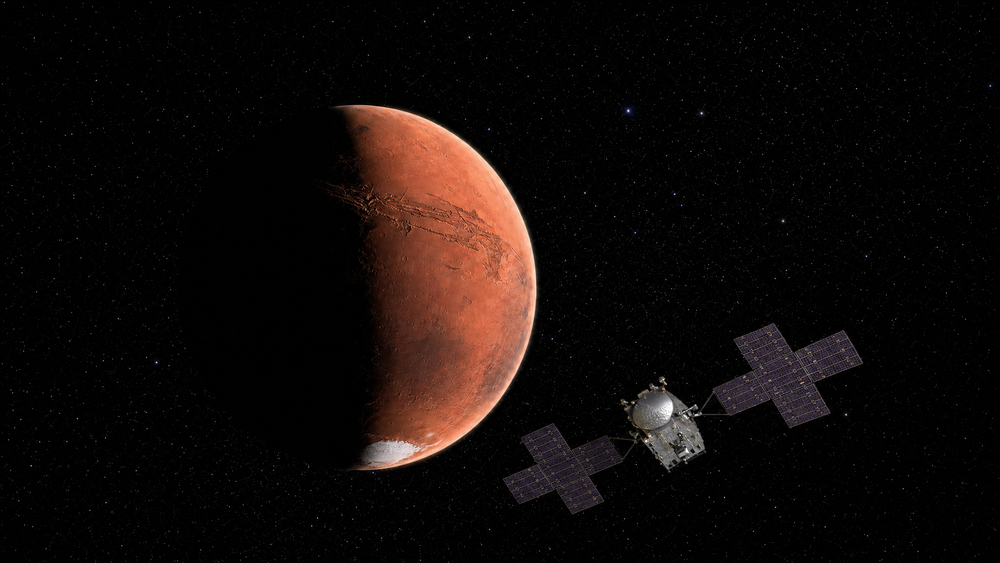
NASA's Psyche spacecraft completed its close approach of Mars on May 15, passing within 2,864 miles (4,609 kilometers) of the planet's surface during a gravity assist maneuver on its journey to asteroid 16 Psyche. The flyby provided a critical speed boost without using onboard propellant, adjusting the spacecraft's orbital plane for the final leg of its trip to a metal-rich asteroid between Mars and Jupiter. During the encounter, Psyche's multispectral imager captured stunning enhanced-color images of Mars, including the 290-kilometer double-ring Huygens crater, wind-blown streaks extending 30 miles across the Syrtis Major region, and the water-ice south polar cap. NASA described the images as showing Mars "from a rare perspective" — views not typically captured by dedicated Mars orbiters. The spacecraft also captured a dramatic crescent Mars image during approach and a nearly "full Mars" view shortly after closest approach.
While the Mars flyby was an opportunistic calibration exercise, it demonstrated that Psyche's instruments are performing well ahead of its arrival at the metallic asteroid, where the spacecraft will spend at least 26 months mapping a world that may be the exposed core of a protoplanet.
THE DOUGH
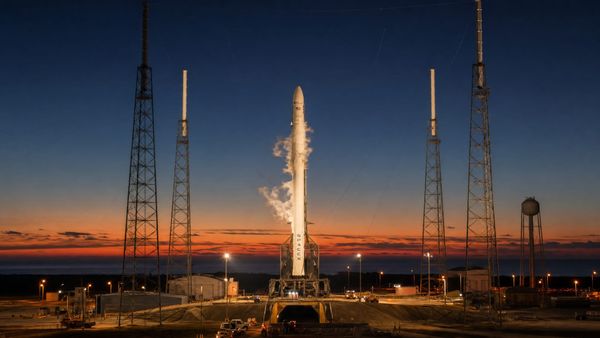
The Psyche mission, managed by JPL with spacecraft built by Maxar Technologies and launched on a SpaceX Falcon Heavy, represents a new class of deep-space exploration focused on understanding planetary formation and resource composition. If asteroid 16 Psyche proves to be as metal-rich as scientists suspect — potentially containing iron, nickel, and precious metals — it could reinforce the long-term investment thesis for asteroid mining companies like AstroForge and TransAstra, even though commercial extraction remains decades away.
We are not financial analysts or investment advisors. Nothing in this newsletter constitutes investment advice. All economic analysis is speculative and for informational purposes only. Do your own research.
THE POSSIBILITIES
The Mars images weren't the mission's primary objective, but they may end up being some of the most scientifically useful data Psyche returns before reaching its target. The enhanced-color views of Martian surface composition from an unusual trajectory could reveal details that dedicated orbiters, constrained to their own orbital paths, simply can't see.
THE HURDLES
Psyche still has years of travel ahead before reaching its asteroid target. The spacecraft won't arrive until 2029, and the scientific questions it aims to answer — whether the asteroid is truly a planetary core — require sustained observation that can't be rushed.
WHAT TO WATCH
- Full release and analysis of all Mars flyby imagery and calibration data
- Psyche's trajectory performance post-gravity-assist
- Scientific papers analyzing the Mars surface composition data from Psyche's unique vantage point