
THE STORY
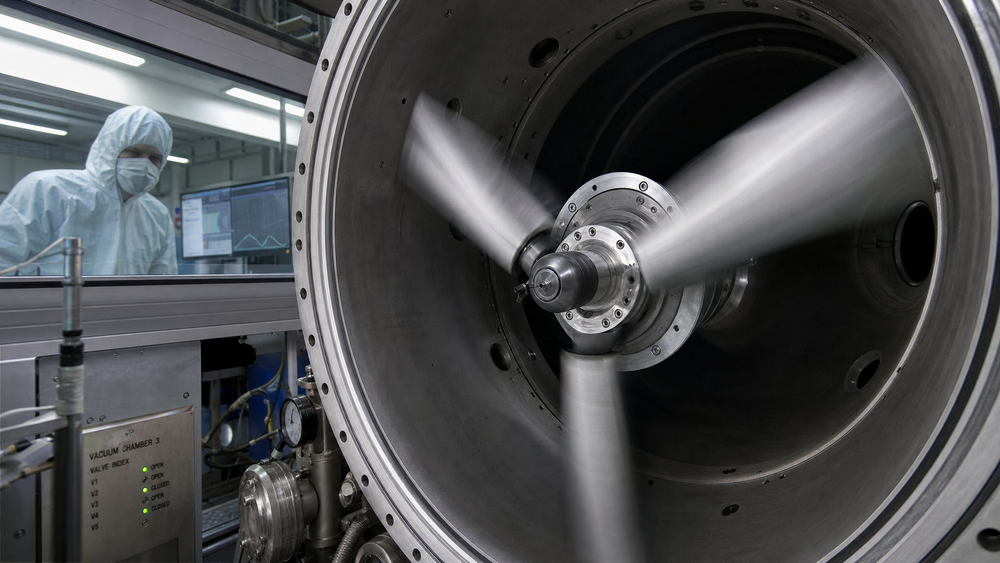
Engineers at NASA's Jet Propulsion Laboratory have pushed next-generation Mars helicopter rotor blades past Mach 1 during testing inside the 25-Foot Space Simulator, a chamber capable of replicating the Red Planet's thin atmosphere. The three-bladed rotors spun fast enough that their tips exceeded the speed of sound without disintegrating — a result that opens the door to far more capable rotorcraft on Mars. Testing took place in November 2025, with data analysis confirming the blades' structural integrity under conditions no Earth helicopter rotor has ever been designed to endure. The Ingenuity helicopter, which flew 72 times on Mars before its mission ended, used two-bladed rotors that approached but never breached the sound barrier. These next-gen blades would carry heavier payloads, fly higher, and cover greater distances.
Supersonic-capable rotors transform what Mars helicopters can do — from short reconnaissance hops to extended scientific surveys, cargo delivery between surface assets, and exploration of terrain inaccessible to rovers. It's the difference between a proof of concept and a workhorse.
THE DOUGH
NASA's Mars Exploration Program remains one of the agency's flagship investments, and next-generation rotorcraft are a key component of the Mars Sample Return architecture and future surface campaigns. AeroVironment, which built Ingenuity, and JPL's partnerships with aerospace contractors position them to capture follow-on development contracts. The broader market for autonomous aerial systems in extreme environments — including defense applications in high-altitude or low-pressure scenarios — could benefit from materials and design innovations proven on Mars.
We are not financial analysts or investment advisors. Nothing in this newsletter constitutes investment advice. All economic analysis is speculative and for informational purposes only. Do your own research.
THE POSSIBILITIES
The real leap isn't speed — it's what supersonic rotors enable for Mars logistics. A helicopter that can carry kilograms of payload across kilometers of Martian terrain turns every future Mars mission into a networked operation rather than a single-point rover crawl. If NASA's Mars base concepts ever materialize, aerial logistics will be as essential as they are on Earth construction sites.
THE HURDLES
Testing in a simulator is not the same as flying on Mars. The rotors must survive dust erosion, thermal cycling between day and night, and the reality of autonomous operation with a multi-minute communication delay. NASA has not yet announced a specific mission to fly these next-gen blades, and the timeline to the next Mars helicopter opportunity depends on broader program decisions and funding.
WHAT TO WATCH
- NASA's announcement of a specific mission for the next-gen Mars helicopter
- Integration testing of full rotor assemblies with flight-weight airframes
- Whether the Mars Sample Return program incorporates aerial assets
- Any commercial partnerships for Mars rotorcraft development