
THE STORY
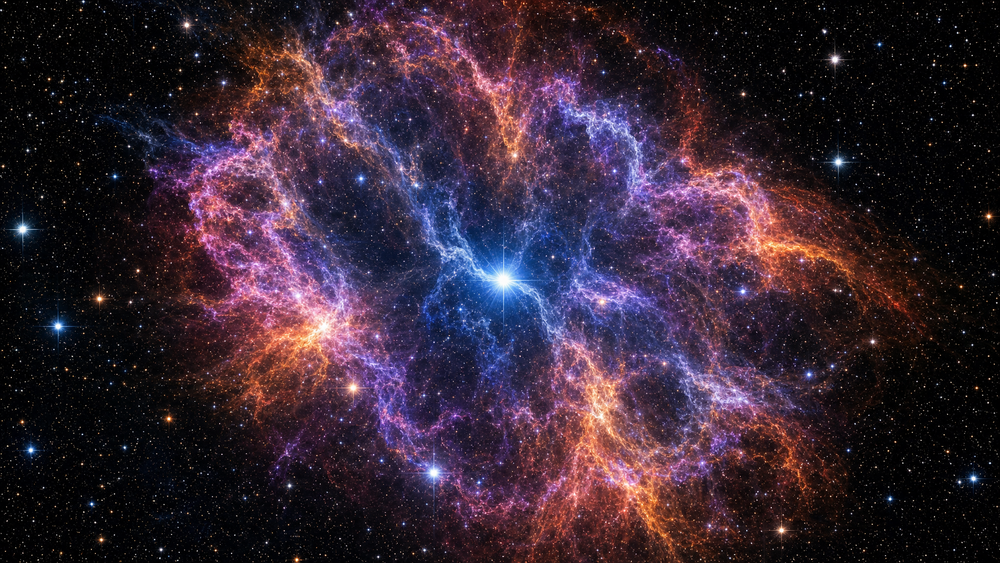
NASA's Fermi Gamma-ray Space Telescope has observed a rare, unusually luminous supernova explosion that appears to have been powered up by the creation of a magnetar — an ultra-magnetic neutron star born in the stellar collapse that triggered the explosion. An international research team studying Fermi data concluded that the supernova was a "super-bright, supercharged" event, far more luminous than typical stellar explosions. Magnetars are the most magnetic objects known in the universe, with magnetic fields a trillion times stronger than Earth's, and their formation can inject enormous energy into the surrounding supernova debris. The observation provides the strongest evidence yet for the theoretical prediction that newly formed magnetars can act as engines that amplify supernova luminosity by orders of magnitude.
The discovery opens a new window into the physics of the most extreme environments in the universe — the first moments after a massive star's core collapses into the densest form of matter known to exist. Understanding magnetar-powered supernovae could help explain a class of mysterious "superluminous supernovae" that have puzzled astronomers for over a decade.
THE DOUGH
Fermi is a NASA flagship mission operated in partnership with the Department of Energy and international partners. The science it produces drives demand for next-generation gamma-ray and multi-messenger observatories. Understanding extreme astrophysical events also has practical implications for space weather forecasting and radiation environment modeling — both critical for human spaceflight beyond low Earth orbit.
We are not financial analysts or investment advisors. Nothing in this newsletter constitutes investment advice. All economic analysis is speculative and for informational purposes only. Do your own research.
THE POSSIBILITIES
If magnetar-powered supernovae are more common than previously thought, they could serve as new "standard candles" for measuring cosmic distances — potentially rivaling Type Ia supernovae as tools for mapping the expansion of the universe and constraining dark energy models.
THE HURDLES
Fermi has been operating since 2008 and is approaching the limits of its designed mission lifetime. Without a successor gamma-ray observatory of comparable sensitivity, the ability to study events like this could be lost for a generation.
WHAT TO WATCH
- Follow-up observations of this supernova with ground-based and space-based telescopes
- Whether the discovery changes the classification of other superluminous supernovae
- NASA's plans for a next-generation gamma-ray telescope mission