THE STORY
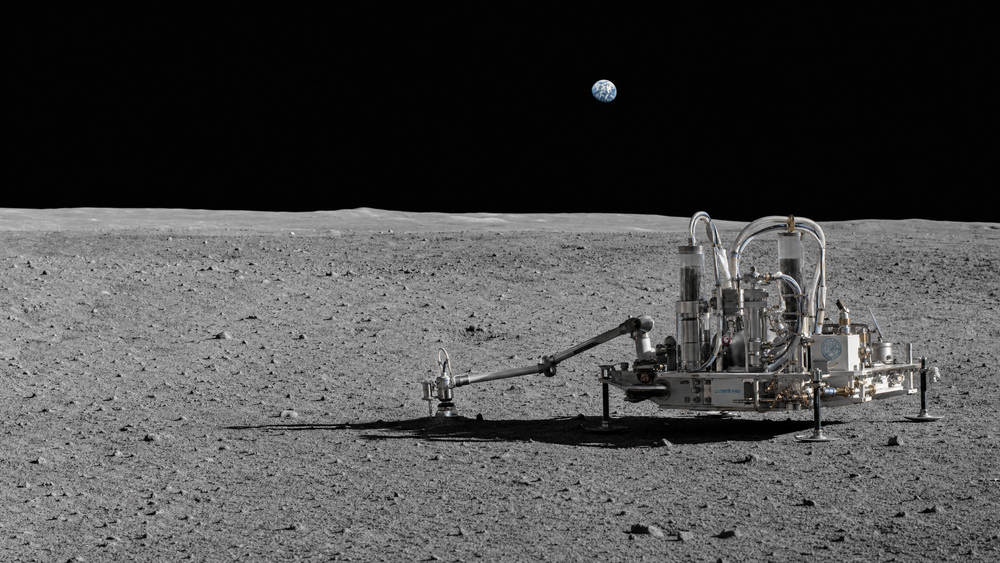
Interlune, a Seattle-based startup founded to extract helium-3 from lunar regolith, has won a $6.9 million Small Business Innovation Research (SBIR) Phase III contract from NASA's Space Technology Mission Directorate. The 18-month contract will fund development of a payload designed to test methods for extracting helium-3 — an isotope deposited on the Moon's surface by the solar wind over billions of years. Helium-3 is exceptionally rare on Earth but could serve as fuel for future fusion reactors and is already valuable for medical imaging, cryogenics, and quantum computing applications. Interlune's approach aims to heat lunar soil to release trapped gases, then separate and collect the helium-3.
This contract represents one of the first NASA-funded efforts to move lunar resource extraction from theory to hardware. It directly supports the agency's broader in-situ resource utilization (ISRU) strategy, which is central to plans for sustained human presence on the Moon.
THE DOUGH
The lunar resource extraction market barely exists today, but NASA's Artemis architecture and the agency's "Ignition" plan for a lunar base are creating real demand signals. Interlune competes in a nascent but potentially enormous field — helium-3 alone, if fusion technology matures, could represent a multi-billion-dollar market. More immediately, lunar ISRU technologies for water ice and oxygen extraction involve companies like Intuitive Machines, Astrobotic, and Honeybee Robotics. NASA's willingness to fund helium-3 specifically suggests the agency sees value beyond just water ice for lunar resources.
We are not financial analysts or investment advisors. Nothing in this newsletter constitutes investment advice. All economic analysis is speculative and for informational purposes only. Do your own research.
THE POSSIBILITIES
Helium-3 is the ultimate dual-use lunar resource. Even before fusion power is viable, helium-3 commands prices exceeding $1 million per kilogram for medical and scientific applications on Earth. If Interlune can demonstrate extraction on the Moon and return even small quantities, it could establish the first off-world commodity supply chain — a precedent with implications far beyond one isotope.
THE HURDLES
Helium-3 exists in vanishingly small concentrations in lunar soil — typically parts per billion — meaning enormous volumes of regolith must be processed. The energy requirements for heating and extraction on the lunar surface are substantial. And there is no existing infrastructure to return extracted materials to Earth at any meaningful scale.
WHAT TO WATCH
- Interlune payload design milestones and planned delivery date
- Which lunar lander mission will carry the extraction payload
- Parallel developments in fusion energy that could increase helium-3 demand