THE STORY
At a press conference at NASA Headquarters on May 26, Administrator Jared Isaacman unveiled the first concrete steps toward building a permanent human outpost on the Moon, announcing nearly $1 billion in initial contracts for lunar rovers, cargo landers, and scout drones. Four companies were selected for the inaugural Moon Base awards, with missions designed to establish infrastructure at the lunar south pole ahead of crewed Artemis landings. "For those waiting patiently, the grand return is close at hand," Isaacman said. Three Moon Base missions are planned for this year alone, described by NASA as "the first of more than a dozen missions that will be announced this year."
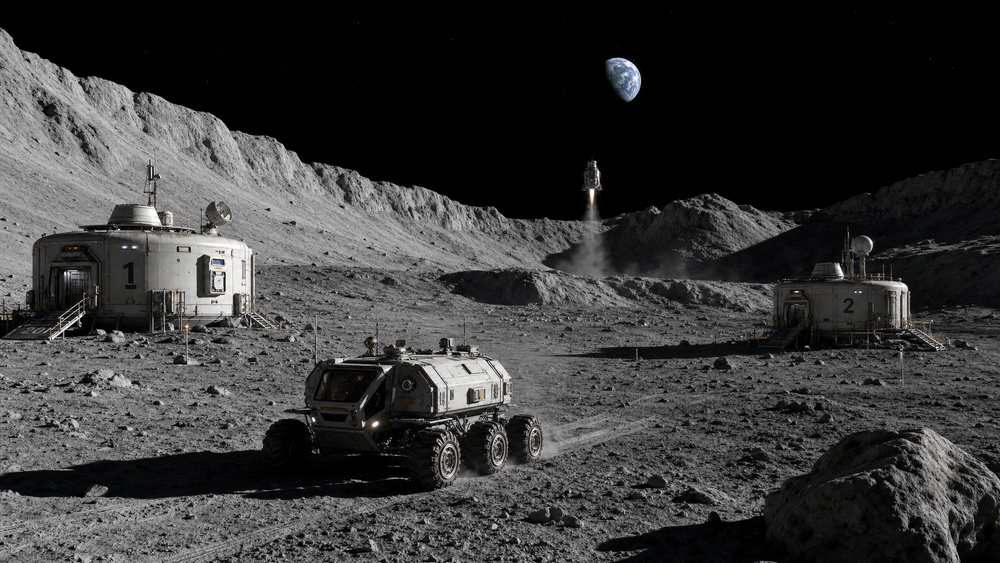
The contracts cover three critical capabilities. First, crewed lunar terrain vehicles — pressurized rovers that will allow astronauts to traverse the rugged south polar terrain and conduct extended surface operations far from their lander. Second, uncrewed cargo landers capable of delivering supplies, scientific instruments, and construction materials to the lunar surface on a recurring cadence. Third, and perhaps most imaginatively, hopping scout drones — small, rocket-powered vehicles that will reconnoiter landing sites, map terrain, and potentially mark the perimeter of the base footprint. Firefly Aerospace won a $75 million subcontract from NASA's Jet Propulsion Laboratory to deliver four such drones to the south pole as part of a high-profile mission called MoonFall.
NASA envisions the base covering "hundreds of square miles" — not a single compact habitat, but a distributed network of sites connected by rovers and serviced by repeated cargo deliveries. Isaacman outlined a cadence of near-monthly robotic landings beginning in 2027, with astronauts potentially living on the lunar surface for months at a time by the early 2030s. The agency also confirmed it will reveal the Artemis III crew on June 9 at Johnson Space Center. Artemis III remains on track for 2027 as an Earth-orbit docking test flight, with the first crewed lunar landing pushed to Artemis IV in 2028 using SpaceX's Starship Human Landing System.
This is a fundamentally different approach from Apollo, where each mission was self-contained and every gram of equipment had to launch from Earth. The Artemis architecture treats the Moon not as a destination to visit but as a place to build — and Moon Base is the construction plan. The commercial model underpinning it, with multiple vendors competing for delivery contracts, mirrors the approach that drove down costs in the Commercial Crew and Commercial Cargo programs. If the cadence holds, the south pole could see its first permanent power systems, communications relays, and supply depots before the end of this decade.
THE DOUGH
The nearly $1 billion in initial awards creates a new recurring revenue stream for commercial lunar companies — not one-shot deliveries, but sustained operations requiring manufacturing at scale. Firefly Aerospace continues to build its position as a lunar logistics provider, while companies across the broader supply chain, including Intuitive Machines, Astrobotic, and Draper, stand to benefit as NASA announces additional missions. The LTV and cargo lander contracts also create downstream opportunities for component suppliers in propulsion, avionics, and thermal management systems.
We are not financial analysts or investment advisors. Nothing in this newsletter constitutes investment advice. All economic analysis is speculative and for informational purposes only. Do your own research.
THE POSSIBILITIES
The most significant aspect of Moon Base isn't any single mission — it's the cadence. Near-monthly robotic landings create a logistics pipeline that transforms the Moon from a science destination into an operational theater, and that pipeline, once established, becomes extraordinarily difficult for any future administration to shut down. This is the kind of programmatic momentum that ensures multi-decade funding regardless of political winds.
THE HURDLES
NASA's timeline depends on commercial landers with a mixed track record — Astrobotic's Peregrine suffered a propellant leak, and Intuitive Machines' first lander tipped over on touchdown. The "hundreds of square miles" vision also raises unresolved questions about Outer Space Treaty compliance, and the agency is navigating budget uncertainty that could slow the ambitious mission cadence.
WHAT TO WATCH
- NASA's Artemis III crew announcement on June 9 at Johnson Space Center
- Which companies receive additional Moon Base contracts through the remainder of 2026
- Firefly's MoonFall drone mission development timeline and technical demonstrations
- SpaceX Starship HLS qualification progress for the Artemis IV crewed lunar landing
- Whether Congress increases NASA's FY2027 budget to support the accelerated Moon Base cadence