
THE STORY
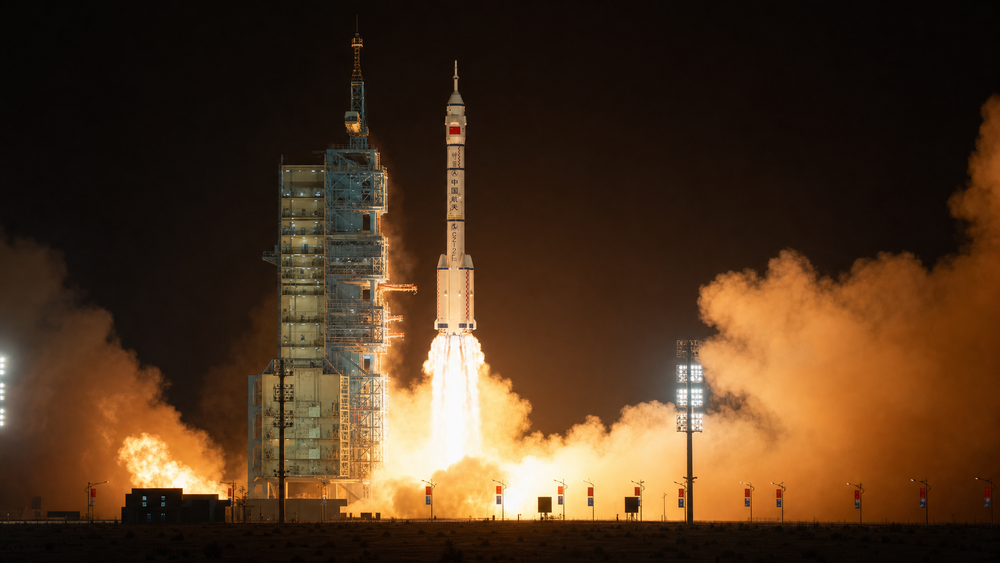
On May 24, 2026, China launched the Shenzhou-23 mission from Jiuquan Satellite Launch Center, sending three astronauts to the Tiangong space station. The crew includes Hong Kong's first-ever astronaut — a former police officer with a doctorate in computer forensics — marking a significant expansion of China's crewed spaceflight program beyond mainland military pilots. One crew member is expected to remain aboard Tiangong for an entire year, which would set a new Chinese record for the longest continuous stay in orbit. The mission relieves an overdue Shenzhou-22 crew and continues China's unbroken streak of permanent occupation of Tiangong since June 2022. Hong Kong's Chief Executive John Lee called the launch a "historic moment" for the city. NASA Administrator Jared Isaacman separately stated that he expects China to perform a crewed flight around the Moon as early as 2027, further ratcheting up perceptions of a space race.
A year-long stay aboard Tiangong puts China on par with the longest individual missions aboard the International Space Station and positions the country to gather critical human physiological data for its planned 2030 crewed lunar landing. The inclusion of a Hong Kong astronaut extends China's political messaging about space as a unifying national project.
THE DOUGH
China's crewed space program is largely state-funded, but the cadence of missions — including a planned 2030 lunar landing — is creating demand for commercial suppliers across the Chinese space ecosystem. Companies like Landspace, iSpace, and Galactic Energy are building launch vehicles to serve the broader Chinese space economy that Tiangong anchors. For Western companies, the competitive pressure is real: if China demonstrates a year-long crewed mission and reaches the Moon by 2030, it strengthens the political case for sustained Artemis funding and commercial lunar services contracts in the U.S. and Europe.
We are not financial analysts or investment advisors. Nothing in this newsletter constitutes investment advice. All economic analysis is speculative and for informational purposes only. Do your own research.
THE POSSIBILITIES
Isaacman's public statement about expecting a Chinese circumlunar mission in 2027 is unusually specific for a sitting NASA administrator. It reads less like intelligence analysis and more like a deliberate framing of the space race narrative to protect NASA's budget heading into Congressional appropriations season. If China actually flies around the Moon before Artemis III lands on it, the political dynamics of U.S. space funding shift dramatically.
THE HURDLES
China's Long March 10 rocket — the heavy-lift vehicle needed for crewed lunar missions — hasn't flown yet. The 2030 timeline for a Chinese Moon landing requires a rapid development cadence that mirrors the pace China set with Tiangong, but landing humans on the Moon is an order of magnitude more complex than operating a space station in low Earth orbit.
WHAT TO WATCH
- Duration of the year-long crew member's stay and any health data China releases
- Long March 10 development milestones and first test flight timeline
- Whether NASA adjusts Artemis III or IV timelines in response to Chinese progress
- Additional non-mainland Chinese astronaut selections for future Shenzhou missions