
THE STORY
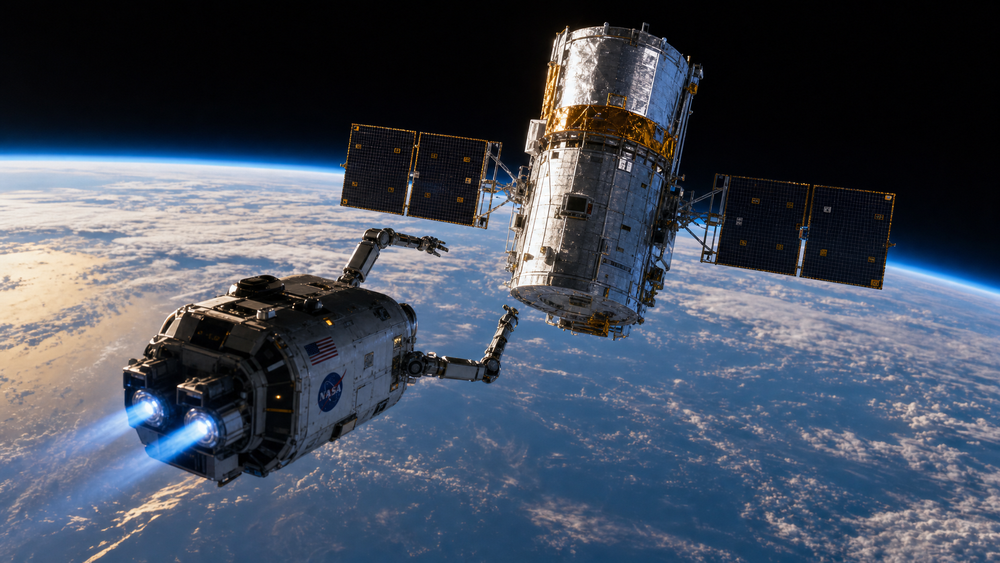
Katalyst Space Technologies' LINK robotic servicing spacecraft has completed a rigorous slate of environmental tests at NASA's Goddard Space Flight Center, clearing one of the final hurdles before a launch as soon as June 2026. The mission will attempt to raise the decaying orbit of NASA's Swift gamma-ray observatory, a $500 million astrophysics satellite that has been operating since 2004 but is gradually losing altitude. NASA awarded Katalyst a $30 million contract for the mission in September 2025. LINK will launch aboard Northrop Grumman's Pegasus XL air-launched rocket, rendezvous with Swift, and boost it to a higher, more stable orbit — extending the telescope's operational life by years.
If successful, the Swift reboost would be one of the first commercial orbital servicing missions to rescue an active NASA science asset. It demonstrates a capability — in-space maintenance and orbit adjustment of existing spacecraft — that could fundamentally change how agencies and operators manage their orbital fleets.
THE DOUGH
Orbital servicing is an emerging market projected to reach billions in revenue as satellite operators seek alternatives to deorbiting and replacing aging but functional spacecraft. Katalyst competes alongside Northrop Grumman (Mission Extension Vehicle), Astroscale, and Orbit Fab. A successful Swift reboost would validate the business case for commercial life-extension services and could open follow-on contracts from both NASA and the Department of Defense for high-value asset preservation.
We are not financial analysts or investment advisors. Nothing in this newsletter constitutes investment advice. All economic analysis is speculative and for informational purposes only. Do your own research.
THE POSSIBILITIES
Orbital servicing doesn't just save satellites — it changes the economics of every future mission. If spacecraft can be refueled, reboosted, or repaired in orbit, the industry shifts from a "build, launch, replace" model to one where on-orbit assets are maintained like aircraft fleets. That's a trillion-dollar structural change in how space infrastructure is valued.
THE HURDLES
Rendezvous and proximity operations with a satellite not designed for servicing are inherently risky. Swift was never built with docking interfaces, so LINK must grapple the telescope using its own mechanisms. Any mishap could damage or destroy a still-operational science asset. The Pegasus XL air-launch vehicle also has a limited flight history in recent years.
WHAT TO WATCH
- LINK launch date confirmation for June 2026
- Rendezvous and grappling attempt results
- NASA follow-on servicing contracts for other aging science missions