
THE STORY
President Trump signed a new National Security Presidential Memorandum on space transportation this week, setting a formal U.S. government target of supporting more than 1,000 rocket launches and reentries per year by 2030. The policy directive, endorsed by the Satellite Industry Association, calls for new spaceport development on federal land, streamlined regulatory frameworks across the FAA and other agencies, and a fundamental rethinking of how the government manages the growing volume of vehicles entering and leaving the atmosphere. The document explicitly frames expanded launch capacity as a national security imperative, not just a commercial convenience.
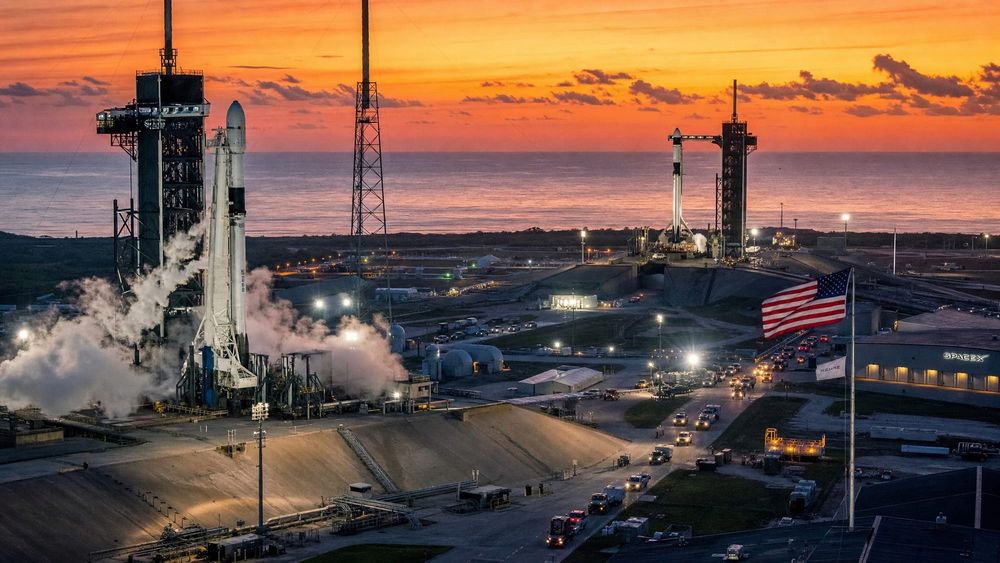
The numbers are staggering in context. In 2025, SpaceX accounted for roughly half of all global orbital launches — and the entire United States conducted approximately 150 orbital missions. Reaching 1,000 launches and reentries by 2030 would require a roughly sevenfold increase in activity within four years. Elon Musk weighed in on X, suggesting SpaceX's Starship program alone could approach a significant fraction of that target by the end of the decade, though he didn't specify exact numbers. The policy acknowledges that existing spaceports cannot handle this volume, noting that "we probably need another site that's capable of heavy and super heavy launch capability" — a clear reference to the need for new facilities beyond Cape Canaveral, Vandenberg, and Starbase.
The directive also addresses spectrum management, launch corridor deconfliction with aviation, and the growing challenge of tracking reusable vehicles that make multiple transits through national airspace. It orders agencies to develop unified frameworks for managing suborbital, orbital, and point-to-point spaceflight operations under a common regulatory umbrella. For an industry that has spent years battling FAA licensing delays — SpaceX alone has publicly clashed with the agency over environmental reviews and launch cadence approvals — the policy represents a top-down mandate to clear the bureaucratic obstacles that have constrained American launch rates. Whether the agencies can actually execute at the speed the directive demands is the trillion-dollar question.
THE DOUGH
A regulatory framework designed for 1,000 launches per year benefits every company in the launch ecosystem: SpaceX, Rocket Lab, ULA, Blue Origin, Relativity Space, Stoke Space, and dozens of smaller firms. Spaceport developers and operators — including the Cecil Spaceport in Florida, the Pacific Spaceport Complex in Alaska, and potential new federal sites — would see massive infrastructure investment. Ground systems companies, range safety providers, and space traffic management firms like LeoLabs and Slingshot Aerospace are direct beneficiaries. The policy also accelerates demand for launch insurance, propellant supply chains, and launch-adjacent services.
We are not financial analysts or investment advisors. Nothing in this newsletter constitutes investment advice. All economic analysis is speculative and for informational purposes only. Do your own research.
THE POSSIBILITIES
The policy's most radical implication isn't the launch count — it's the regulatory precedent. By establishing spaceflight volume as a national security priority, the administration creates political cover for agencies to fast-track approvals that would have taken years under previous frameworks. If this sticks across administrations, it could do for spaceflight what the Interstate Highway Act did for automotive transportation: create infrastructure that outlasts any single presidency.
THE HURDLES
Presidential memoranda are policy statements, not legislation. Without Congressional funding for new spaceports, range upgrades, and FAA staff, the directive risks becoming aspirational rather than operational. Environmental reviews for new launch sites can take years, and local opposition to rocket noise and launch frequency is a growing political force, particularly in Texas and Florida coastal communities.
WHAT TO WATCH
- FAA response: does the agency accelerate licensing timelines for SpaceX and other operators?
- Identification and environmental review timelines for new federal spaceport sites
- Congressional appropriations for launch infrastructure in the FY2027 budget
- SpaceX Starship launch cadence as a leading indicator of whether 1,000 is achievable
- How Space Force integrates the directive into its own launch architecture planning
Void Economy is researched, written, and illustrated with AI, reviewed and edited by a real, live, flesh-n-blood human.