

THE STORY
China has postponed its landmark Chang'e 7 lunar south pole mission to 2027, pulling the plug on what would have been the most ambitious robotic Moon mission ever attempted. The mission was originally set to launch on August 24, with a Long March 5 rocket standing ready at the Wenchang Spacecraft Launch Site on Hainan Island. A brewing storm near the launch site forced an initial weather delay — but then Chinese space authorities made the far more consequential decision to postpone the entire mission, stating that "the Chang'e 7 mission does not meet the conditions for launch" and citing a need for "absolute success."
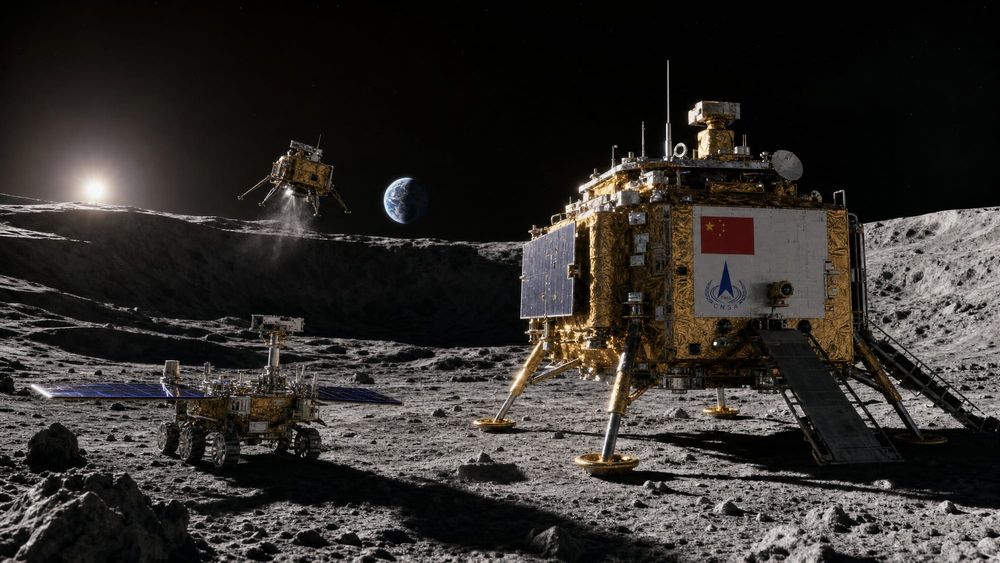
The mission architecture explains the caution. Chang'e 7 isn't a single spacecraft — it's a multi-vehicle convoy designed to deploy in concert near the lunar south pole. The mission stack includes an orbiter, a lander, a rover, and a small hopping vehicle specifically designed to descend into permanently shadowed craters to search for water-ice deposits. No space agency has ever sent a hopper to the Moon's south pole. The mission also carries an array of scientific instruments to study the lunar environment, including sensors to characterize the radiation environment, measure surface temperatures in permanently shadowed regions, and analyze regolith composition. The orbiter would serve double duty as a communications relay for future Chinese lunar surface missions.
The delay has significant implications for the global lunar race. NASA's Artemis III mission — which aims to land the first astronauts near the south pole — is also on a fluid timeline, with SpaceX's Starship Human Landing System still working toward orbital demonstrations. China's Chang'e 6 mission successfully returned samples from the lunar far side in 2024, establishing China as the only nation with operational experience in far-side landings. A successful Chang'e 7 would have extended that lead by establishing a persistent science station near potential water-ice resources — the most strategically valuable real estate on the Moon. The delay likely stems in part from fallout from a recent Long March 7A launch failure that occurred just days before, which may have rattled confidence across China's launch enterprise and prompted a broader safety review. A failed Chang'e 7 would be a geopolitical setback that China's lunar program — and its leadership — cannot afford.
THE DOUGH
The delay opens a window for Western lunar competitors. Companies like Intuitive Machines, Astrobotic, and Firefly Aerospace — all under contract to deliver NASA payloads to the lunar south pole — now have additional time to establish operational presence before China arrives. The delay could also affect procurement timelines for Chinese companies building instruments and subsystems for Chang'e 7 and subsequent missions. For investors in the Western cislunar economy, the delay slightly reduces the competitive urgency but doesn't change the long-term trajectory: the lunar south pole remains the most contested destination in the solar system.
We are not financial analysts or investment advisors. Nothing in this newsletter constitutes investment advice. All economic analysis is speculative and for informational purposes only. Do your own research.
THE POSSIBILITIES
The most telling signal isn't the delay — it's the language. "Absolute success" suggests China's leadership views Chang'e 7 as a prestige mission with zero margin for failure. A crash on the lunar south pole would hand NASA a narrative victory and erode confidence in China's deep-space capabilities at a critical moment. The extra year could yield a dramatically more capable mission — but it also gives NASA's Artemis program breathing room it desperately needs.
THE HURDLES
The 2027 timeline depends on resolving whatever technical issues prompted the postponement, completing the Long March 7A failure investigation, and ensuring the complex multi-vehicle deployment sequence is fully validated. The lunar south pole's extreme terrain and lighting conditions make this mission inherently harder than Chang'e 6's far-side landing, and the hopper vehicle is an entirely unproven spacecraft class.
WHAT TO WATCH
- Chinese official statements on the specific technical issues behind the postponement
- Long March 7A failure investigation results and return-to-flight timeline
- Whether NASA adjusts its Artemis south pole landing timeline in response
- Progress on the Chang'e 7 hopper vehicle's qualification testing
- Any indications that Chang'e 8 — China's planned south pole research station precursor — is also affected
Void Economy is researched, written, and illustrated with AI, reviewed and edited by a real, live, flesh-n-blood human.


