
THE STORY
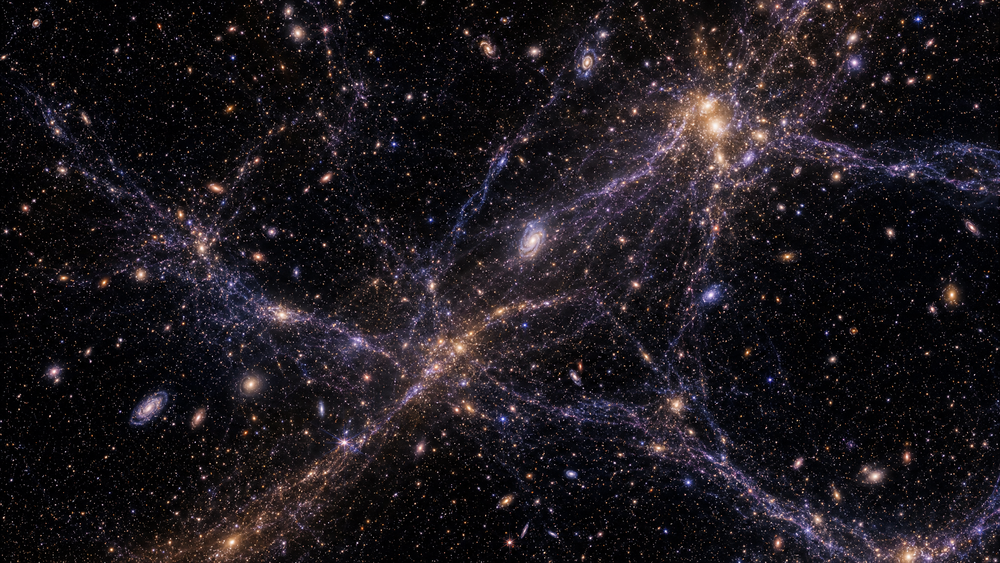
Using the James Webb Space Telescope, astronomers have mapped the "cosmic web" — the vast filamentary network of galaxies, gas, and dark matter that forms the largest known structure in the universe — with unprecedented detail. The observations reveal how galaxies are distributed along interconnected strands of matter stretching across billions of light-years, separated by immense voids. The data provides the most detailed view yet of how structure in the universe evolved from the near-uniform conditions of the early cosmos to the complex web we see today.
The cosmic web is the scaffolding of the universe itself. Mapping it in this detail gives cosmologists their best tool yet for testing theories about dark matter, dark energy, and the fundamental forces that govern how the universe grows.
THE DOUGH
JWST's continued delivery of groundbreaking science reinforces the value of NASA's investment in flagship observatories and strengthens the case for next-generation space telescopes. Northrop Grumman (JWST prime contractor), Ball Aerospace (optics), and the broader precision optics supply chain benefit from the demonstrated success. The cosmic web data will also feed into simulations run on supercomputers, driving demand for high-performance computing resources at institutions and national labs worldwide.
We are not financial analysts or investment advisors. Nothing in this newsletter constitutes investment advice. All economic analysis is speculative and for informational purposes only. Do your own research.
THE POSSIBILITIES
Detailed maps of the cosmic web could reveal whether dark energy behaves differently in dense filaments versus voids — a potential crack in our current understanding of cosmology that, if confirmed, would rewrite fundamental physics textbooks.
THE HURDLES
JWST has finite observing time and enormous demand from competing science programs. Mapping the cosmic web at this resolution requires hundreds of hours of telescope time, limiting how much of the sky can be surveyed. Ground-based survey telescopes like the Vera Rubin Observatory will need to complement JWST's deep but narrow observations.
WHAT TO WATCH
- Follow-up JWST observations targeting specific cosmic web filaments
- Vera Rubin Observatory first-light timeline for wide-field cosmic web surveys
- Dark energy measurement updates from JWST and DESI collaborations
- Computational cosmology papers using the new data to refine dark matter models