
THE STORY
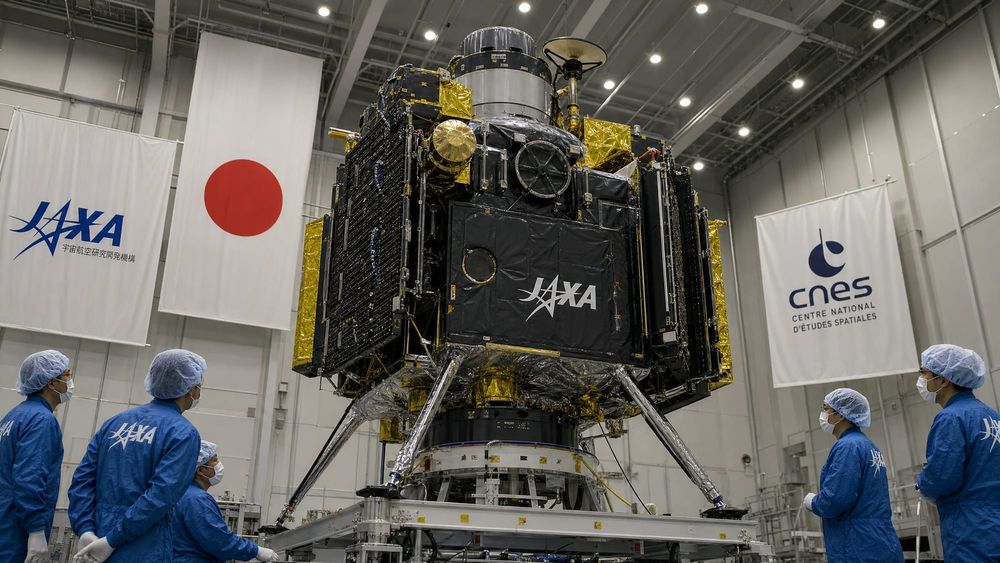
Japan recently unveiled the flight hardware for its MMX (Martian Moons eXploration) mission, the most ambitious planetary sample-return mission since NASA's OSIRIS-REx. Developed by JAXA, Japan's space agency, the MMX spacecraft is designed to travel to Mars orbit, land on the tiny Martian moon Phobos, collect surface samples, and return them to Earth — a feat no space agency has ever accomplished. The mission is set to launch on October 19, 2026, giving the spacecraft a few months to complete final integration and testing before departing for the Red Planet.
Phobos is one of the most scientifically tantalizing objects in the inner solar system. Measuring roughly 27 by 22 by 18 kilometers, the potato-shaped moon orbits so close to Mars — just 6,000 kilometers above the surface — that material blasted off Mars by asteroid impacts has likely accumulated on Phobos over billions of years. By sampling Phobos's regolith, MMX could effectively return pieces of Mars without the enormous cost and complexity of a Mars surface sample-return mission. The spacecraft carries a suite of instruments including cameras, a near-infrared spectrometer, and a gamma-ray neutron spectrometer, plus a small rover developed jointly by CNES (France) and DLR (Germany) that will be deployed to Phobos's surface before the main spacecraft touches down to collect its samples.
If successful, MMX would return to Earth around 2031 with the first samples from the Martian system, arriving years before NASA's Mars Sample Return mission — which remains mired in budget overruns and redesign cycles. For Japan, which has demonstrated deep-space capability with the Hayabusa and Hayabusa2 asteroid sample-return missions, MMX represents a logical next step in a program that has consistently punched above its weight. The October launch window is dictated by orbital mechanics: Mars and Earth align for efficient transfers roughly every 26 months, and missing this window would delay the mission by over two years.
THE DOUGH
MMX is a showcase for Japanese and European aerospace suppliers. The mission's international partnerships with CNES, DLR, and NASA create technology-sharing pathways that benefit all participating nations' space programs. Success would bolster JAXA's position in the competitive planetary exploration landscape and could attract commercial partnerships for future deep-space missions. For investors, the mission highlights Japan's growing role as a space technology exporter — Rocket Lab's acquisition of iQPS radar satellites and Japan's broader commercial space ecosystem both benefit from JAXA's demonstrated competence.
We are not financial analysts or investment advisors. Nothing in this newsletter constitutes investment advice. All economic analysis is speculative and for informational purposes only. Do your own research.
THE POSSIBILITIES
If Phobos samples contain Martian material — as planetary scientists strongly suspect — MMX could deliver the first analysis of Mars rocks years before NASA's embattled Mars Sample Return. Japan could leapfrog the United States in one of planetary science's most high-profile races, and do it at a fraction of the cost.
THE HURDLES
Landing on Phobos is extraordinarily difficult. The moon's weak and irregular gravity field — it's not even spherical — makes descent and touchdown dynamics unpredictable. Phobos's surface composition and bearing strength are poorly understood, creating risk that the sampling mechanism could encounter unexpected conditions. The multi-year transit to Mars and back also exposes the spacecraft to deep-space radiation and system degradation.
WHAT TO WATCH
- MMX launch on October 19, 2026, and successful Earth departure
- Mars orbit insertion approximately one year after launch
- Phobos surface characterization from orbit before landing site selection
- Franco-German rover deployment and surface operations on Phobos
- NASA Mars Sample Return redesign progress — will MMX deliver Mars material first?
Void Economy is researched, written, and illustrated with AI, reviewed and edited by a real, live, flesh-n-blood human.