
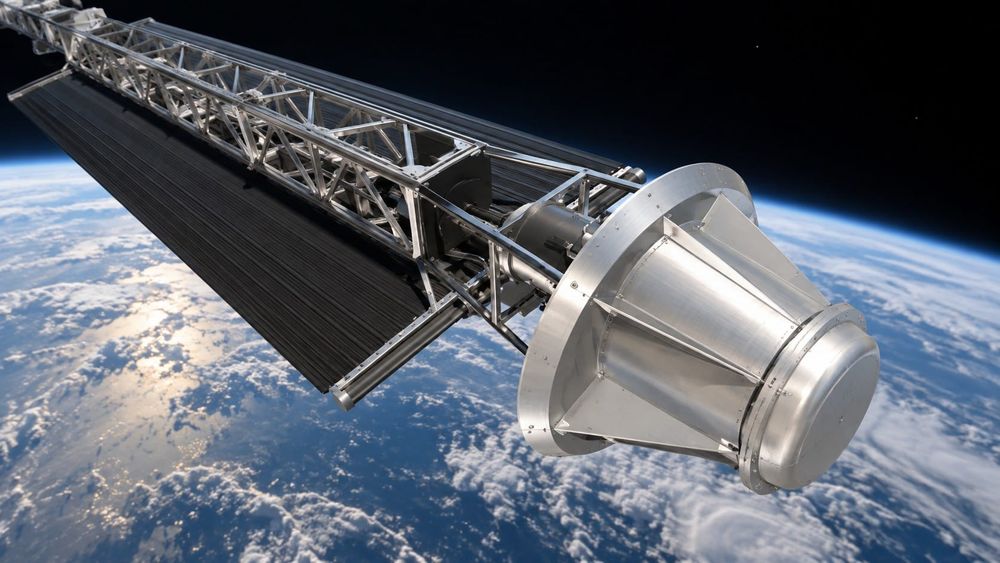

THE STORY
Antares has received a $161 million U.S. Department of Defense award to advance nuclear power for space, which the company describes as the largest DoD space-nuclear award to date. The supplied material does not specify the reactor’s output, fuel form, mass or flight date, so the contract should be understood as a major development program rather than an imminent operational power plant. Even with those details unresolved, the scale of the award signals serious institutional demand for energy systems that can operate far beyond the practical limits of conventional solar arrays.
Space power is a mission-defining constraint. Solar panels perform well in many Earth orbits, but available sunlight drops with distance from the Sun and disappears entirely in shadow. Batteries can bridge short dark periods, yet their mass grows quickly when a spacecraft must survive long nights or power-intensive operations. Nuclear systems offer sustained output independent of illumination, potentially supporting sensors, communications, propulsion support equipment or surface infrastructure where solar generation is intermittent or impractical.
The Moon makes the requirement easy to visualize. Operations near the lunar poles can encounter severe lighting geometry, while other locations face roughly two weeks of darkness during the lunar night. Deep-space missions face an even harsher energy budget. A compact reactor could keep instruments warm, communications active and mobile systems charged without building enormous solar and battery installations. For military users, independence from sunlight could also permit spacecraft architectures that are less constrained by orientation and orbital lighting.
The award matters because space nuclear systems must solve much more than nuclear physics. Hardware has to survive launch vibration, reject heat in vacuum, remain controlled through faults and meet exacting safety rules before leaving Earth. A reactor that works on the ground can still fail as a spacecraft subsystem if its shielding, thermal management or deployment architecture is too heavy. Antares now has a substantial mandate to attack those integration problems. Success would not merely improve existing missions; it could allow spacecraft and surface systems to operate continuously in places where today’s power budgets force long periods of inactivity.
THE DOUGH
The program could direct spending toward reactor components, specialized fuels, radiation-tolerant electronics, thermal systems and launch-safety engineering. If Antares produces flight-ready hardware, civil lunar missions and deep-space projects could become follow-on markets beyond defense. Reliable nuclear power would also increase the value of energy-hungry payloads that cannot operate continuously on current spacecraft buses.
We are not financial analysts or investment advisors. Nothing in this newsletter constitutes investment advice. All economic analysis is speculative and for informational purposes only. Do your own research.
THE POSSIBILITIES
Continuous power could change spacecraft design more profoundly than faster propulsion by allowing instruments, computers and communications links to remain active through darkness. It may also make high-duty-cycle computing in remote orbits practical without enormous deployable arrays.
THE HURDLES
The supplied material does not establish that Antares has a flight-qualified reactor. Mass, heat rejection, launch approval, fuel availability and public acceptance all stand between a development award and routine orbital use.
WHAT TO WATCH
- Disclosure of the reactor’s power output and intended mission class
- Ground demonstrations under vacuum and thermal conditions
- Specific fuel and launch-safety plans
- Selection of a host spacecraft or surface demonstrator
- A credible path from prototype to flight qualification
Void Economy is researched, written, and illustrated with AI, reviewed and edited by a real, live, flesh-n-blood human.