
THE STORY
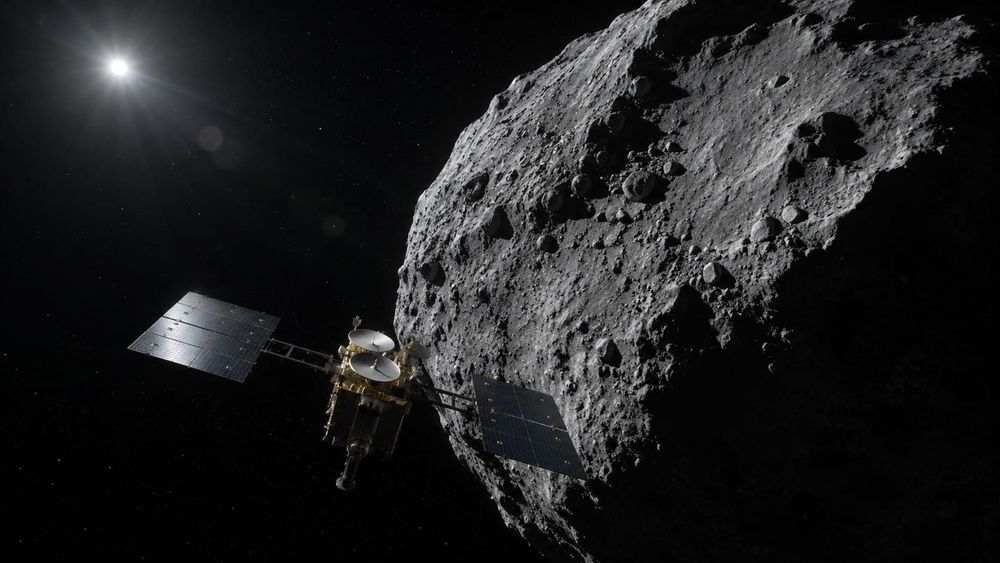
JAXA's Hayabusa2 spacecraft — the probe that already made spaceflight history by scooping pristine material from the surface and subsurface of asteroid Ryugu and delivering it to Earth in December 2020 — is about to attempt one of the closest and most dangerous asteroid flybys ever conducted. On July 5, Hayabusa2 will scream past a small near-Earth asteroid at extraordinarily tight range, pushing the boundaries of deep-space navigation in an encounter scientists are calling one of the riskiest space-rock flybys in spaceflight history.
What makes this flyby so compelling is the combination of extreme proximity, high relative velocity, and near-total ignorance about the target. Unlike Ryugu, which the spacecraft orbited for eighteen months and mapped down to centimeter-scale resolution, the flyby target is essentially a stranger. Scientists know its approximate orbit and rough size, but its shape, spin state, surface texture, and whether it harbors any tiny moons are all unknowns that will be revealed only in the seconds around closest approach. "We're going to discover another beast to put in the zoo of asteroids," the mission team has said — capturing the pure spirit of exploration that drives Hayabusa2's extended mission. The spacecraft's original Ryugu investigation delivered revelations that reshaped our understanding of the early solar system: amino acids, water-altered minerals, and organic compounds locked in carbonaceous material billions of years old. Those samples are still being analyzed in laboratories worldwide, yielding new papers every month. But rather than retire a spacecraft with plenty of remaining propellant and a proven instrument suite, JAXA redirected Hayabusa2 toward additional asteroid encounters, squeezing maximum science from hardware that has already far exceeded its design life.
The technical challenge of a super-close flyby is immense. At high encounter velocities, the navigation team must thread the spacecraft through a corridor narrow enough to capture scientifically useful images and spectral data while avoiding a collision with an object whose precise dimensions remain uncertain until the final moments. Onboard cameras and instruments will have only a brief window — potentially just seconds — to observe the asteroid's surface geology, regolith properties, and any signs of activity or outgassing. Every frame will need to be precisely timed and pointed. If successful, the flyby will deliver humanity's first close-up look at a fundamentally different type of asteroid than Ryugu, broadening the catalog of small-body diversity in a way that matters not only for planetary science but for future asteroid mining and planetary defense. Each new asteroid type that gets characterized up close adds a data point to models that underpin both hazard assessment and resource extraction strategies for the coming decades.
THE DOUGH
Asteroid characterization data feeds directly into the business cases of companies like AstroForge and TransAstra, which are developing in-space resource extraction systems that depend on knowing what asteroid types contain which materials. The flyby also reinforces Japan's position as a leader in small-body science, a domain with growing commercial and defense relevance as governments invest in planetary defense capabilities. JAXA's extended mission model — maximizing return on existing hardware — is itself a template for cost-effective deep-space operations that commercial operators are watching closely.
We are not financial analysts or investment advisors. Nothing in this newsletter constitutes investment advice. All economic analysis is speculative and for informational purposes only. Do your own research.
THE POSSIBILITIES
The real significance may be what this flyby reveals about the diversity of near-Earth asteroid compositions. If the target turns out to be metallic or silicate-rich rather than carbonaceous like Ryugu, it could validate economic models suggesting that different asteroid types contain commercially viable concentrations of platinum-group metals or water ice — the two resources most critical to any future space-based economy.
THE HURDLES
A super-close flyby of a poorly characterized asteroid is inherently high-risk. If the target is larger, more irregularly shaped, or surrounded by debris not predicted by ground-based observations, the spacecraft could be damaged or lost. The extreme speed of the encounter also means there is no second chance — every instrument must work perfectly in a window measured in seconds.
WHAT TO WATCH
- First images from the July 5 flyby revealing the asteroid's shape and surface
- Whether spectral data reveals a different compositional class than Ryugu
- Detection of any small companion moonlets or debris around the target
- How JAXA's extended mission model influences future sample-return mission planning