THE STORY
In a breathtaking display of contract velocity, the U.S. Space Force awarded SpaceX two massive contracts totaling $6.45 billion in the span of days. The first, worth $2.29 billion, tasks SpaceX with building the Space Data Network (SDN) Backbone — a proliferated low Earth orbit communications constellation designed to serve as the U.S. military's primary space-based data relay network. The second, worth $4.16 billion, contracts SpaceX to build and deploy a satellite constellation under the Space-Based Airborne Moving Target Indicator (SB-AMTI) program — a sensor network designed to detect and track aircraft, cruise missiles, drones, and other airborne threats anywhere on Earth from space. The SB-AMTI constellation is a key component of President Trump's "Golden Dome" missile defense architecture.
The SDN Backbone effectively makes SpaceX the builder of the military's internet in space — the data transport layer that connects sensors to shooters across the Department of Defense's entire space architecture. The program manager stated plainly: "We aren't trading speed for scale; we are demanding both." The SB-AMTI award is arguably even more consequential. Current airborne target tracking relies heavily on expensive, vulnerable aircraft like the E-3 AWACS and E-7 Wedgetail. A persistent satellite constellation that can track every aircraft and missile on the planet from orbit transforms the geometry of air defense — there is nowhere to hide from space-based sensors that operate 24/7 across the entire globe.
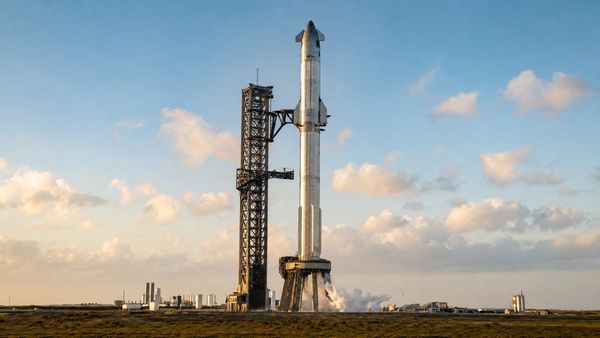
These awards came just hours before the Blue Origin explosion, making the timing almost surreal. SpaceX is now simultaneously the dominant commercial launch provider, the builder of the world's largest communications constellation (Starlink), the developer of humanity's most powerful rocket (Starship), a major AI compute provider (via its $30 billion Google deal and Anthropic partnership), and now the Pentagon's primary contractor for both space-based communications and space-based surveillance. Combined with the company's IPO prospectus revealing that government contracts already generate roughly one-fifth of SpaceX's revenue, these awards cement a level of U.S. military dependence on a single private company that is historically unprecedented — and that dependence is only deepening as Blue Origin's competitive alternative sits in ruins on a Florida launch pad.
THE DOUGH
The $6.45 billion in new contracts adds significant revenue visibility to SpaceX's IPO story, which targets a $1.77 trillion valuation. Defense primes like Northrop Grumman, L3Harris, and Raytheon are both competitors and potential subcontractors on these programs. Satellite component suppliers — including Apex Space (which separately raised $200 million at a $2.3 billion valuation this week and partnered with Northrop Grumman on Golden Dome interceptors), antenna manufacturers, and sensor providers — stand to benefit from the proliferated architecture. The military space sector is becoming investable at a scale that was previously confined to classified programs, with publicly traded companies like Rocket Lab, Planet Labs, and BlackSky positioned in adjacent market segments.
We are not financial analysts or investment advisors. Nothing in this newsletter constitutes investment advice. All economic analysis is speculative and for informational purposes only. Do your own research.
THE POSSIBILITIES
The SB-AMTI constellation doesn't just track threats — it creates a persistent, global, real-time picture of every aircraft in flight. That capability has civilian applications that dwarf the military use case: imagine air traffic management, disaster response coordination, or maritime domain awareness powered by the same sensor network. If the military system proves reliable, a commercial derivative could reshape aviation safety worldwide.
THE HURDLES
Concentration risk is the elephant in the room. The U.S. military is building its most critical space architecture on a single company's platforms at the same moment that company is going public, adding shareholder pressure and governance complexity. Congressional scrutiny of SpaceX's growing government market share — and Elon Musk's political entanglements — could lead to mandated competition requirements on future contracts. There is also the technical challenge of building and deploying hundreds of satellites on accelerated timelines while simultaneously managing Starlink expansion, Starship development, and an IPO.
WHAT TO WATCH
- SpaceX's satellite production rate — can it simultaneously build Starlink, SDN, and SB-AMTI constellations?
- Whether Congress mandates second-source requirements for future military space contracts
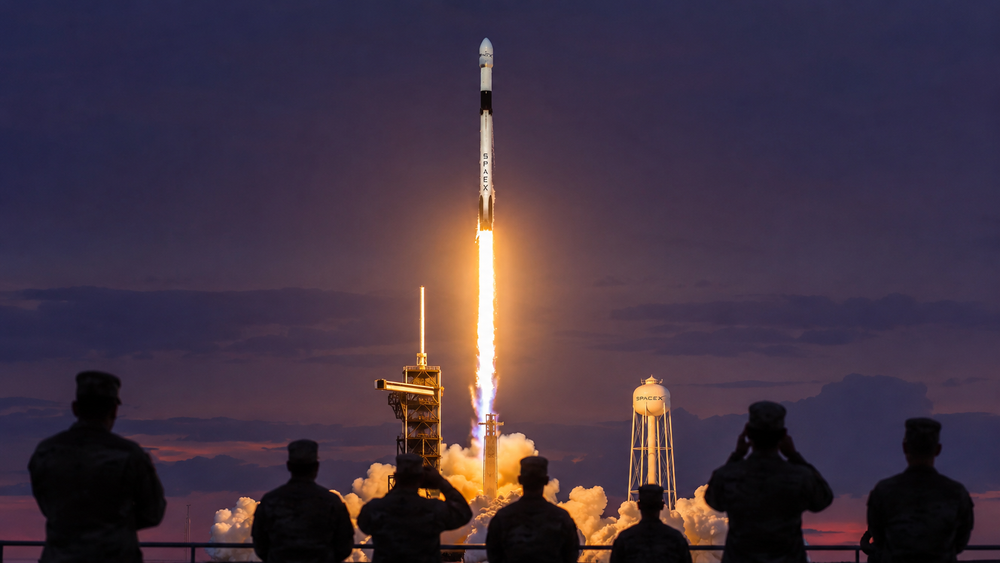
- Blue Origin's recovery timeline and whether the Space Force shifts any New Glenn-manifested national security payloads to Falcon 9
- Apex Space's progress on Golden Dome space-based interceptors with Northrop Grumman, targeting 2027 delivery
- International reaction to a U.S. space-based global airborne surveillance capability