THE STORY
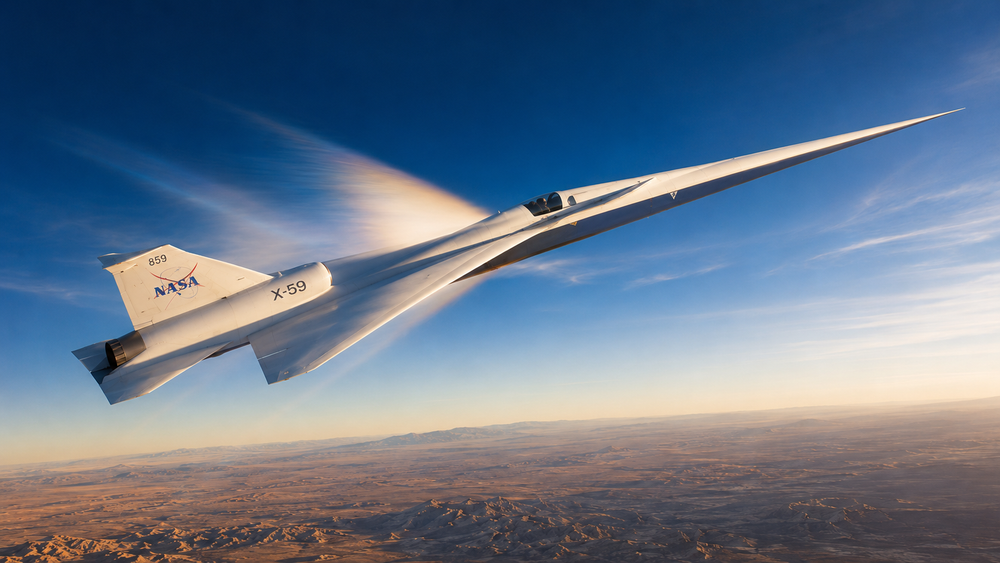
On Friday, June 5, NASA's experimental X-59 quiet supersonic research aircraft broke the sound barrier for the first time, reaching a top speed of approximately Mach 1.1 — about 713 mph — at an altitude of 43,400 feet over Edwards Air Force Base in California. NASA test pilot Jim "Clue" Less took off at 11:08 a.m. PDT and flew for 81 minutes, carefully transitioning from subsonic to supersonic speeds in a flight that focused on evaluating the aircraft's handling qualities across the speed regime. The milestone sets the stage for the X-59 to demonstrate its core purpose later this year: proving that a carefully shaped airframe can transform the explosive sonic boom into a barely perceptible "thump" on the ground.
The X-59 is the centerpiece of NASA's Quesst mission, a program designed to gather data that could convince regulators to lift the decades-old ban on commercial supersonic flight over land. Since the Concorde era, supersonic aircraft have been prohibited from overland routes in the United States because of the disruptive sonic booms they generate. The X-59's distinctive elongated nose — the aircraft stretches 99.7 feet long but is only 29.5 feet wide — is engineered to prevent the shockwaves generated during supersonic flight from coalescing into the sharp, window-rattling boom that made Concorde flights a noise nuisance. Instead, the aircraft's shape disperses shockwaves so that they arrive at the ground as a gentle, diffuse sound roughly as loud as a car door closing.
Now that the X-59 has proven it can fly supersonic, NASA will progressively expand the flight envelope before beginning community overflight tests, where it will fly supersonic over selected U.S. cities while ground sensors and resident surveys measure and record the perceived noise impact. That acoustic data will be delivered to the FAA and international regulators as evidence to potentially rewrite noise standards. If the data supports the case, the regulatory change could open the door to a new generation of supersonic commercial airliners that could cut transatlantic flight times in half — a market that multiple aerospace companies, including Boom Supersonic and Spike Aerospace, are positioning to serve. The X-59's first supersonic flight, decades in the making and built on billions of dollars in research, means the era of quiet supersonic travel is no longer theoretical — it's an engineering reality waiting for regulatory permission to take off.
THE DOUGH
A regulatory green light for quiet supersonic overland flight would open a market that multiple studies have estimated at tens of billions of dollars annually. Boom Supersonic, which is developing the Overture airliner, has pre-orders from American Airlines, United Airlines, and Japan Airlines. Lockheed Martin built the X-59 airframe under contract with NASA and holds deep institutional knowledge of supersonic design. Engine makers like GE Aerospace and Rolls-Royce would see demand for next-generation powerplants optimized for sustained supersonic cruise. The broader aerospace supply chain — from advanced composites to high-temperature materials — stands to benefit from what would be an entirely new class of commercial aircraft.
We are not financial analysts or investment advisors. Nothing in this newsletter constitutes investment advice. All economic analysis is speculative and for informational purposes only. Do your own research.
THE POSSIBILITIES
The underappreciated implication is military, not commercial. If quiet supersonic flight becomes routine, defense applications — reconnaissance platforms, rapid-response transports, even stealthy cruise missiles — could exploit the same shockwave-shaping principles. The acoustic data NASA gathers could also find applications in reducing noise from hypersonic vehicles and reentry spacecraft, making future Starship operations over populated areas less disruptive.
THE HURDLES
Community overflight testing hasn't started yet, and public perception of even reduced sonic noise is notoriously hard to predict. Regulatory change requires international coordination through ICAO, a process that could take years even with strong data. The X-59 is a single-seat research aircraft — scaling its design principles to a full-size commercial airliner with passengers and engines introduces entirely new engineering challenges.
WHAT TO WATCH
- X-59's next flight blocks pushing deeper into the supersonic envelope and expanding to higher Mach numbers
- Timeline for the first community overflight tests and which U.S. cities are selected
- FAA and ICAO's formal response to early acoustic data
- Boom Supersonic's Overture development progress and whether airlines firm up or expand their pre-orders