
THE STORY
On July 2, 2026, a Northrop Grumman Pegasus XL rocket air-launched from a modified L-1011 aircraft over the Pacific Ocean near Kwajalein Atoll, carrying Katalyst Space Technologies' Link spacecraft on a first-of-its-kind mission: intercepting and reboosting NASA's Neil Gehrels Swift Observatory before it reenters Earth's atmosphere. Swift, launched in 2004, has spent over two decades detecting gamma-ray bursts, supernovae, and other high-energy cosmic events — but recent extreme solar activity during Solar Cycle 25 has dramatically increased atmospheric drag on its orbit, pushing the telescope dangerously low. Without intervention, Swift could burn up as soon as late 2026.
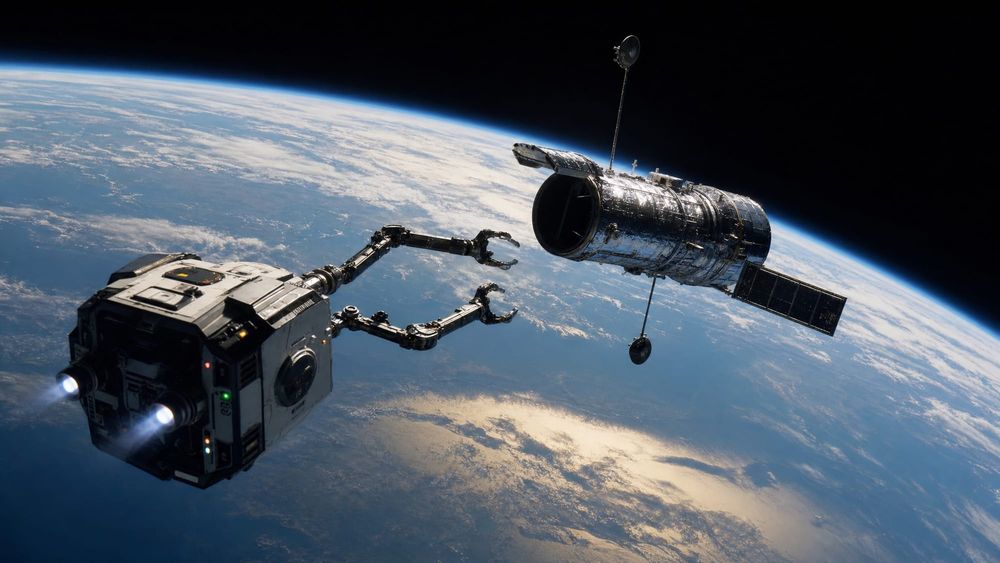
The mission profile is extraordinary. Katalyst's Link spacecraft — a compact robotic servicing vehicle — must autonomously rendezvous with Swift in low Earth orbit, dock with a satellite that was never designed to be serviced, and use its own propulsion to boost the observatory to a higher, safer orbit. This isn't like servicing the Hubble Space Telescope, which was designed from the outset with astronaut-accessible handholds and modular instruments. Swift has no servicing interfaces. Link must approach, grapple, and push — all robotically, with no human in the loop during the critical proximity operations. The Pegasus XL that delivered Link is itself historic: this was likely the final flight of the air-launched rocket, which has been flying since 1990 and pioneered the concept of launching orbital payloads from beneath the wing of a carrier aircraft.
What makes this mission genuinely significant beyond the cool factor is what it proves about commercial orbital servicing. If Link successfully reboosts Swift, it validates an entire category of space capability — life extension of aging but still-functional satellites through commercial servicing. NASA has dozens of spacecraft worth billions that could benefit from similar interventions, and the Department of Defense has even more. The precedent set here could spawn a servicing industry worth billions annually, transforming satellites from disposable assets into maintainable infrastructure. Katalyst is a small company, but the capability it's demonstrating is enormous.
THE DOUGH
Orbital servicing is projected to become a multi-billion-dollar market by the early 2030s. Katalyst's success would validate the economics for competitors including Northrop Grumman (whose MEV vehicles already service geostationary satellites), Astroscale (orbital debris removal), and Orbit Fab (in-space refueling). NASA and DoD budget lines for satellite life extension could expand significantly if this mission succeeds — it's far cheaper to reboost a working telescope than to build and launch a replacement. Insurance companies and satellite operators are watching closely, as servicing could fundamentally change satellite depreciation models.
We are not financial analysts or investment advisors. Nothing in this newsletter constitutes investment advice. All economic analysis is speculative and for informational purposes only. Do your own research.
THE POSSIBILITIES
If a small startup can rescue a flagship NASA observatory for a fraction of what a replacement would cost, the logical next question is: why are we still treating satellites as throwaway hardware? Successful servicing of a spacecraft that wasn't designed for it could trigger a fundamental rethink of satellite design philosophy — future spacecraft may be built with standardized docking interfaces from day one, creating a plug-and-play servicing ecosystem in orbit.
THE HURDLES
Rendezvous and proximity operations with an uncooperative target in LEO is among the hardest things you can do in orbital mechanics. Swift is tumbling slightly due to a prior reaction wheel failure, which complicates approach and capture. If Link damages Swift during grapple, NASA could lose both the telescope and the servicing vehicle. And the Pegasus XL launch faced a weather delay — a reminder that even the delivery system has margin-thin reliability.
WHAT TO WATCH
- Link's approach and docking timeline — proximity operations are expected within days of launch
- Post-reboost Swift observatory health checks and resumption of science operations
- Whether NASA issues follow-on servicing contracts to Katalyst or competitors
- Astroscale's and Orbit Fab's response — commercial servicing market positioning
- DoD interest in applying the same capability to military satellites