

THE STORY
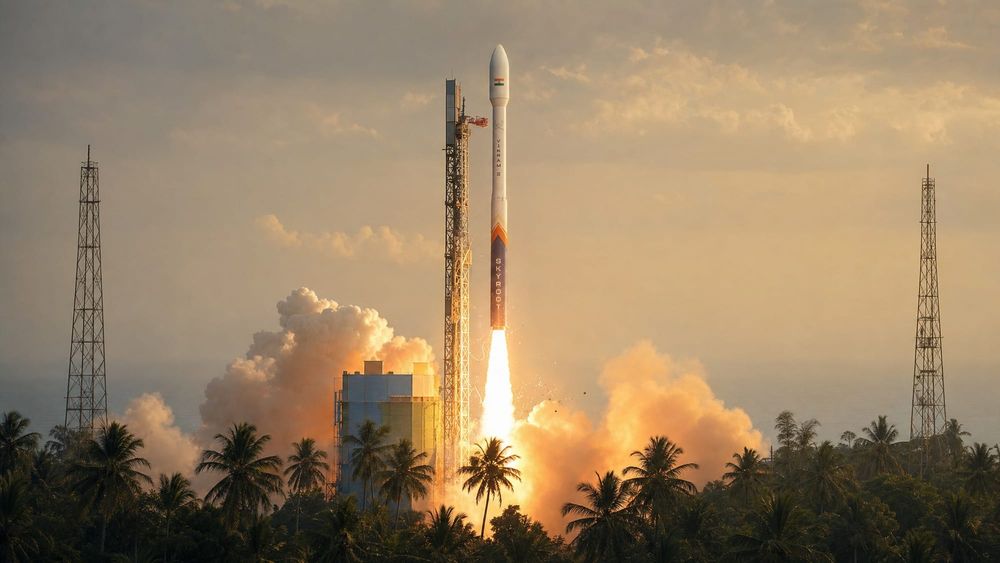
Skyroot Aerospace's Vikram-1 rocket successfully lifted off on its inaugural flight on July 18, becoming the first commercial Indian rocket to reach orbit. The launch, conducted from India's Satish Dhawan Space Centre on the country's southeastern coast, marks a watershed moment for Asia's rapidly expanding commercial space sector. Vikram-1 is a four-stage vehicle standing roughly 24 meters tall, employing three solid-propellant stages topped by a liquid upper stage called Raman-I, powered by a pressure-fed bipropellant engine. The rocket is designed to place up to 300 kilograms into a 500 km sun-synchronous orbit — a sweet spot for Earth observation and small-satellite constellations.
The mission's significance extends far beyond the hardware. India's Department of Space enacted an emergency administrative directive on July 14 restricting ISRO personnel from departing to private firms, a move directly targeting the talent drain driven by Skyroot, Agnikul, and other domestic startups that have been aggressively recruiting from the government agency. The directive underscores just how seriously New Delhi takes its emerging commercial launch ecosystem — and how quickly private players are scaling. Skyroot, backed by a $1.1 billion valuation, has positioned Vikram-1 as a dedicated small-satellite launcher intended to serve both Indian and international customers, competing directly with Rocket Lab's Electron and the growing roster of global small-launch vehicles.
The success comes at a pivotal time for the global launch market. BryceTech data shows SpaceX accounted for half of all orbital launches in 2025, and the U.S. Space Force just tripled its National Security Space Launch contract ceiling, signaling surging demand. Yet access to orbit remains a bottleneck for non-American customers. India's combination of low labor costs, proven solid-motor manufacturing expertise inherited from ISRO's PSLV program, and a growing domestic satellite customer base gives Skyroot a structural advantage that few competitors can match. The Indian government's reformed space policy, which opened the sector to private operators in 2020, is now producing its first orbital-class results. Vikram-1's flight also validated the rocket's carbon-composite motor casings and 3D-printed injector components — technologies Skyroot developed to shave mass and manufacturing time compared to traditional approaches. The company has stated that a larger Vikram-II variant, capable of placing over a metric ton into LEO, is already in active development.
THE DOUGH
Skyroot's orbital debut validates the investment thesis behind India's commercial space sector, which has attracted over $400 million in venture funding since deregulation. Launch service providers like Skyroot and Agnikul now compete for contracts from OneWeb, Planet Labs, and a growing roster of Indian defense and commercial satellite operators. India's broader $13.3 billion semiconductor push and $6.5 billion smartphone manufacturing program signal a government committed to making the country a full-stack space-electronics supplier. International small-satellite operators seeking launch diversity away from SpaceX's dominance now have a credible Asian alternative.
We are not financial analysts or investment advisors. Nothing in this newsletter constitutes investment advice. All economic analysis is speculative and for informational purposes only. Do your own research.
THE POSSIBILITIES
The ISRO personnel restriction tells a story that the launch itself doesn't: India's private space sector is growing so fast it's creating a genuine talent war with the government. If Skyroot can demonstrate rapid launch cadence — not just a single success — it could become the low-cost launch provider of choice for the massive Asian satellite market, where proximity and regulatory alignment matter as much as price.
THE HURDLES
A single successful flight does not make a launch provider. Skyroot must now demonstrate repeatability and reliability across multiple missions before commercial customers will commit manifest slots. The Falcon 9 sales freeze anxiety reported by Payload highlights how dependent the entire satellite industry is on proven, high-cadence launchers — a status Vikram-1 is years from achieving.
WHAT TO WATCH
- Skyroot's next Vikram-1 launch date and customer manifest announcements
- Whether the ISRO personnel exit restrictions accelerate or slow India's private space momentum
- Vikram-II development timeline and payload capacity targets
- Agnikul Cosmos and other Indian startups reaching orbital milestones
- International satellite operators booking Vikram-1 for dedicated rideshare missions


