
THE STORY
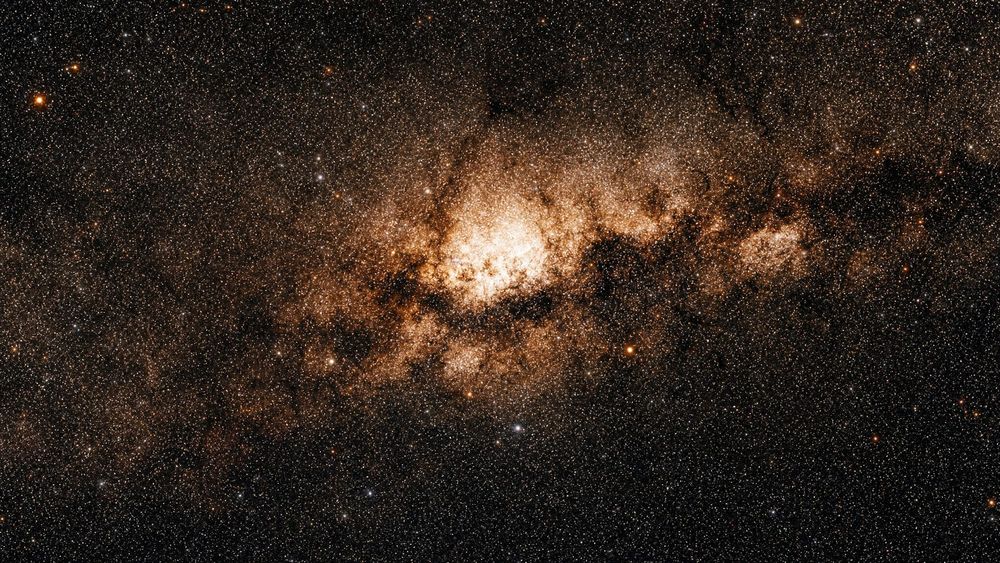
The ESA/NASA Euclid space telescope has produced the largest and most detailed photograph ever taken of the Milky Way's galactic center, capturing more than 60 million individual stars and at least 50 known exoplanet systems in a single sweeping mosaic. The image, released June 24, covers a region of the sky that overlaps with the area NASA's upcoming Nancy Grace Roman Space Telescope will survey after its launch this summer — giving astronomers an unprecedented preview and jumpstart on one of Roman's core science programs. Euclid, which launched in 2023 as a dark-energy and dark-matter mapper, was not primarily designed to study our own galaxy's core. But its wide-field infrared instruments proved ideal for peering through the dust and gas that obscure the galactic center from optical telescopes, revealing structures and stellar populations that have never been resolved at this scale.
The "crowded heart" of the Milky Way is one of the most dynamically extreme environments in the galaxy — home to the supermassive black hole Sagittarius A*, dense star clusters, and regions of intense star formation. Mapping it at this resolution allows astronomers to trace the orbital motions of millions of stars, reconstruct the galaxy's formation history, and identify rare objects like hypervelocity stars being flung outward by gravitational encounters with the central black hole.
THE DOUGH
Euclid's data is publicly available, feeding into research programs at institutions worldwide and driving demand for high-performance computing to process the massive datasets. The overlap with Roman's planned survey creates synergies that benefit both missions' science teams and the companies providing data processing infrastructure. Airbus Defence and Space, which built Euclid's spacecraft, gains further validation of its science mission platform.
We are not financial analysts or investment advisors. Nothing in this newsletter constitutes investment advice. All economic analysis is speculative and for informational purposes only. Do your own research.
THE POSSIBILITIES
This dataset could reveal whether the Milky Way's central region harbors intermediate-mass black holes — objects between stellar-mass and supermassive black holes that have never been conclusively detected. Finding them would solve a decades-old mystery in astrophysics and reshape models of galaxy evolution.
THE HURDLES
The galactic center is so crowded that disentangling individual stellar motions from the background requires years of repeated observations. Euclid's primary mission is dark energy, not galactic archaeology, so repeat visits to this field may not be prioritized by the mission team.
WHAT TO WATCH
- Scientific papers emerging from the 60-million-star catalog
- Roman Space Telescope's complementary observations after its August launch
- Discovery of new stellar populations or exotic objects in the galactic center data