

THE STORY
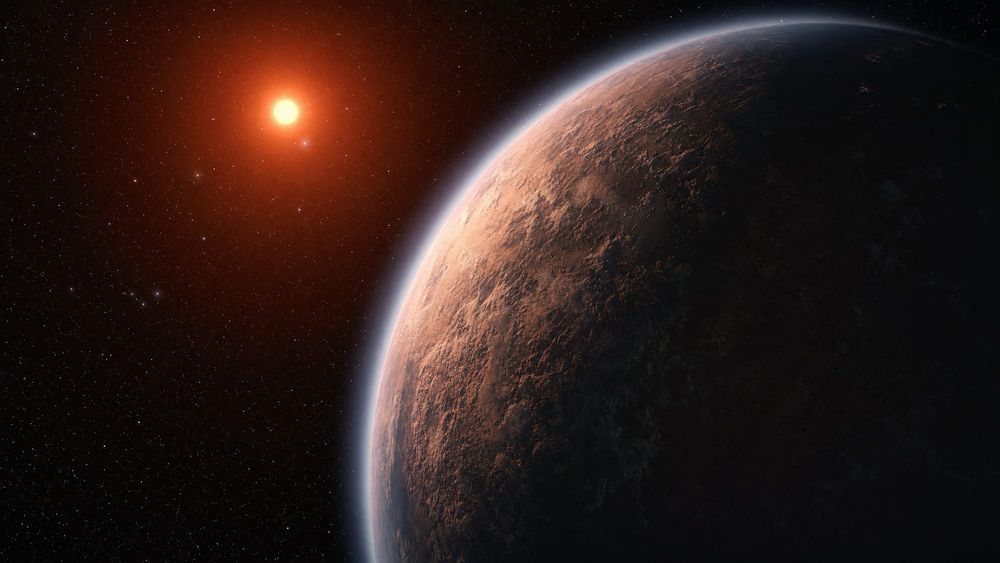
Astronomers have confirmed the first-ever detection of an atmosphere surrounding LHS 1140 b, a rocky exoplanet 48 light-years away that sits within the host red dwarf star's habitable zone — the orbital region where liquid water could theoretically exist on a planet's surface.
The discovery, reported in a study published this week, represents one of the most significant milestones in the decades-long search for potentially habitable worlds beyond our solar system. While thousands of exoplanets have been catalogued since the 1990s, confirming an atmosphere on a rocky world in the right orbital sweet spot has remained agonizingly elusive.
The detection was made possible by the extraordinary spectroscopic precision of the James Webb Space Telescope, which observed the planet during multiple transits in front of its star. By analyzing starlight filtered through the planet's thin atmospheric envelope, researchers were able to identify spectral absorption features consistent with atmospheric gases. The specific composition details are still being refined, but the presence of any atmosphere at all on a rocky habitable-zone world is the scientific breakthrough the exoplanet community has been chasing since JWST launched in December 2021. Previous JWST observations had detected atmospheres on gas giants and sub-Neptunes — interesting, but not the kind of worlds where life as we know it could arise. A rocky planet with an atmosphere in the habitable zone crosses a fundamentally different threshold.
This discovery also arrives alongside a separate finding this week: astronomers using JWST discovered a previously hidden giant planet in the Beta Pictoris system, one of the most intensely studied young planetary systems in the Milky Way. Together, these results underscore that JWST is not merely confirming what ground-based telescopes suspected — it is uncovering entirely new worlds and capabilities that were invisible before. The habitable-zone atmosphere finding will immediately focus attention on NASA's upcoming Nancy Grace Roman Space Telescope, slated to launch no earlier than August 30 aboard a SpaceX Falcon Heavy from Kennedy Space Center. Roman's wide-field coronagraph instrument is designed to directly image exoplanets and their environments, providing a complementary capability to JWST's transit spectroscopy. The two observatories working in tandem could, within the decade, begin to assemble a genuine census of habitable worlds in our galactic neighborhood.
THE DOUGH
The discovery validates the multi-billion-dollar investment in space-based observatories and will intensify demand for follow-up observation time on JWST and future telescopes. Instrument suppliers like Ball Aerospace, Northrop Grumman (JWST prime contractor), and L3Harris (Roman optics) benefit from growing political support for flagship astrophysics missions. Ground-based extremely large telescopes under construction — the ESO's ELT, GMT, and TMT — also see their science cases strengthened, as atmospheric characterization of habitable-zone planets will require every tool available.
We are not financial analysts or investment advisors. Nothing in this newsletter constitutes investment advice. All economic analysis is speculative and for informational purposes only. Do your own research.
THE POSSIBILITIES
This finding doesn't prove the planet is habitable — but it changes the question from "do rocky planets in habitable zones even retain atmospheres?" to "what's in them?" That subtle shift unlocks an entirely new field of comparative planetology that could, within this decade, produce the first tentative biosignature detections — chemical combinations in an atmosphere that are difficult to explain without biology.
THE HURDLES
Atmospheric detection on a rocky world is extraordinarily difficult, and false positives remain a persistent concern. A separate study published this week warned that AI tools used to analyze such data can be "repeatedly fooled into mistaking non-life for life." Confirmation will require multiple independent observations using different techniques, which could take years of scarce JWST time.
WHAT TO WATCH
- Peer review and independent confirmation of the atmospheric detection
- JWST Cycle 5 observation time allocations for habitable-zone follow-up
- Nancy Grace Roman Space Telescope launch on August 30 and commissioning timeline
- Whether the atmosphere shows any potential biosignature gases in follow-up spectroscopy
- ESO Extremely Large Telescope first-light timeline for ground-based atmospheric characterization


